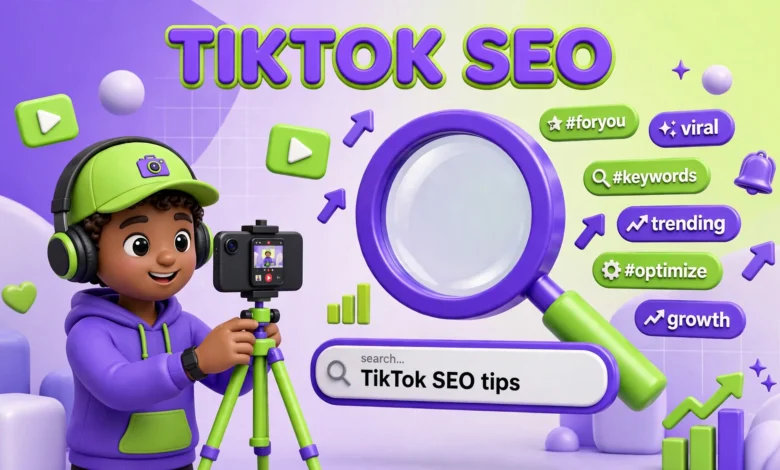
TikTok is no longer just a place where people scroll for fun. For a growing share of users, it is the first place they go when they want an answer, a recommendation, or a how to guide. That shift has created a whole new skill for creators: TikTok SEO, the practice of making your videos easy for TikTok search to find and show to people who are actively looking for your topic.
This guide explains how TikTok search works in 2026, the five keyword layers TikTok reads in every video, how to research the words your audience actually types, and a five step strategy you can use on every video. It also covers what separates TikTok SEO from Google SEO, and measuring search traffic.
Why is TikTok now a search engine?
For years, search meant Google. Then a generation of users started searching on the apps where they already spent their time, and TikTok led that change. An Adobe Express survey from February 2026 found that 49 percent of US consumers use TikTok as a search engine, and among Gen Z the figure reaches 65 percent. Those numbers explain why TikTok has invested so heavily in search features, including search suggestions and a dedicated Creator Search Insights tool.
People search TikTok differently from Google. On Google, users type a question and expect a page of links. On TikTok, they type a short phrase and expect a video that shows the answer in seconds. Common searches include restaurant recommendations, product reviews, outfit ideas, and quick tutorials. The intent is the same as Google, but the format is video first, and the winner is the video that answers fastest and most clearly.
This matters because search traffic behaves differently from For You traffic. A video that ranks for a popular search can keep getting views for weeks or months after it leaves the For You feed. That evergreen traffic is exactly what most creators are missing. If you already have a growth plan for short form video, our guide on how to grow on TikTok in 2026 pairs well.
What are the 5 keyword layers TikTok reads?
TikTok does not rank videos by caption alone. It reads five keyword layers in every video, and each one gives the algorithm more evidence about what your video is about. The more layers that agree on the same topic, the clearer your video is. The five layers are spoken audio, on screen text, caption, hashtags, and profile bio.
Spoken audio
TikTok transcribes everything you say in a video, and that transcript is one of the strongest ranking signals. If your video is about budget skincare, and you say the words budget skincare in the first few seconds, TikTok knows what the video is about even before it reads your caption. Saying your keyword out loud matters more than hiding it in a hashtag.
On screen text
Text overlays are also read and indexed. A title card that says your keyword in large text at the start of the video reinforces the topic and helps viewers who watch without sound understand the video instantly. Keep the text short and readable.
Caption
Your caption is still important, and it is the layer most creators already optimise. Put your main keyword near the start of the caption, not buried at the end after three lines of emojis. A caption that leads with the keyword will beat one that hides it in a pile of tags.
Hashtags
Hashtags are the weakest of the five layers on their own, but they still help TikTok categorise your video. Use three to five niche hashtags that match your topic closely, rather than twenty broad ones. A video about easy weeknight dinners will rank better with a focused tag than with a generic tag like food.
Profile bio
Your bio tells TikTok what your whole account is about, and that context lifts every video you post. If your bio says you post budget travel tips for students, TikTok is more likely to rank your travel videos for travel searches. A clear bio with your niche keywords is one of the easiest SEO wins, and it costs nothing.
How do you research TikTok keywords?
Good TikTok SEO starts before you record, with the words your audience actually types. The best research tool is the search bar itself. Type a topic into the TikTok search bar and watch the autosuggest list. Those suggestions are real searches from real users, ranked by popularity. If you type budget skincare and TikTok suggests budget skincare routine for oily skin, that longer phrase is a real search with real demand.
Creator Search Insights is TikTok’s own keyword tool, available in the Creator tools section of the app. It shows trending search topics, how popular each topic is, and whether interest is rising or falling. Use it to find gaps: a topic with high search interest but few good videos is a better target than a topic where the top results are already excellent.
Do not copy a competitor’s keywords blindly. A keyword that works for a creator with a million followers may be too competitive for a new account. Start with longer, more specific phrases, such as easy high protein breakfast for students instead of just breakfast. These have less competition, and the viewers who find you through them are more likely to watch, save, and follow.
What is the 5 step TikTok SEO strategy?
- Say your keyword in the first 3 seconds. Open with the topic out loud, so the transcript and the viewer both know what the video is about.
- Put the keyword in on screen text. Add a short title card with the keyword in large, readable text at the start.
- Lead your caption with the keyword. Start the caption with the keyword or a close variation, then add one helpful sentence.
- Add 3 to 5 niche hashtags. Pick hashtags that match your topic closely, not broad tags.
- Stay consistent in your niche. Posting regularly about the same topic trains both the algorithm and your audience.
Consistency deserves special attention, because it is the step most creators skip. One optimised video will not rank your account for a topic. Ten videos on the same topic, each using the same keyword layers, will. TikTok needs repeated evidence before it trusts that your account is an authority on a subject. Pick a niche you can post about for months.
What ranking signals matter most on TikTok search?
Keywords get your video into the search results, but engagement decides where it ranks and whether it stays there. Watch time and completion rate matter most. If most viewers watch your video to the end, TikTok reads that as a strong sign the video answered their search. Aim for a completion rate above 70 percent on short videos, which means keeping videos tight and delivering the payoff early.
Saves and shares matter more than likes for search ranking. A like is a quick tap, while a save means the viewer wants to return to your video, and a share means they thought it was worth sending to someone else. Both are strong signals that your video solved a real problem. Design videos that deserve saves: checklists, step by step guides, and product comparisons. Our guide on how to fix a TikTok shadowban explains how engagement patterns affect whether TikTok keeps showing your videos.
Comments help too, especially comments that use the keyword. Replying to comments quickly keeps the conversation going and signals that your video is active and useful. Watch time, saves, shares, and comments together tell TikTok that your video is genuinely helpful to the people who clicked it.
How is TikTok SEO different from Google SEO?
TikTok SEO and Google SEO share the same idea, which is matching content to search intent, but they work very differently in practice. Google ranks pages largely on backlinks, domain authority, and detailed written content, and a good page can rank for years. TikTok ranks videos largely on watch behaviour, keyword alignment, and freshness, and a good video can rank for weeks or months, but rarely for years.
Google searchers usually want depth: a long article, a detailed comparison, or a complete guide. TikTok searchers usually want speed: a 30 second demonstration, a quick recommendation, or a visual answer they can grasp instantly. The best TikTok SEO content is often a short, focused video that answers one question well, while the best Google SEO content is often a long, thorough page.
Another difference is how authority is built. On Google, authority comes slowly from links and reputation over years. On TikTok, authority can be built faster, because a new account that consistently answers a niche well can start ranking within weeks. The trade off is that TikTok authority is more fragile: stop posting about your niche for a month, and your rankings can fade. Google rankings are more durable, TikTok rankings are more responsive.
How do you measure TikTok search traffic?
TikTok Analytics shows you how people find your videos. In the Analytics section, open the Content tab, select a video, and look at the traffic sources. One of the sources is Search, and it tells you how many views came from people who typed a search term and clicked your video. You can also see which search terms brought viewers to a specific video, which is direct feedback on your keyword choices.
Track search traffic once a week, not once a day, because daily numbers jump around too much to read clearly. Note which videos get the most search views, which search terms bring people in, and whether search views are growing as a share of your total views. If search views are rising while your total views stay flat, your SEO is working.
Creator Search Insights also shows which of your videos are performing well in search, so check it alongside Analytics. For the official documentation on how TikTok search and Creator Search Insights work, see the TikTok Support Center and the TikTok website. The honest truth is that search traffic grows slowly at first. Most creators see a few search views per video in the first month, then a steady climb as they publish more optimised videos in the same niche. Treat it as a compounding asset, not an overnight trick.
TikTok SEO is not a secret hack, and anyone selling a guaranteed ranking method is selling hype. It is a simple discipline: research what people search for, answer it clearly across all five keyword layers, make a video worth finishing and saving, and repeat in the same niche. Do that consistently, measure your search traffic weekly, and the search engine inside TikTok will start working for you.
TikTok SEO FAQs
What is TikTok SEO?
TikTok SEO is the practice of optimising your videos so they rank in TikTok search results. It means using the keywords your audience searches for across five layers, spoken audio, on screen text, caption, hashtags, and profile bio, then making videos viewers watch to the end, save, and share.
How do I find keywords for TikTok SEO?
Use the TikTok search bar autosuggest to see real searches, and use Creator Search Insights in the Creator tools section to find trending search topics and gaps. Start with longer, specific phrases that match your niche closely, because they have less competition.
Do hashtags still matter for TikTok SEO?
Yes, but they are the weakest of the five keyword layers on their own. Use 3 to 5 niche hashtags that match your topic closely. Spoken audio, on screen text, and your caption carry more weight for ranking, so optimise those first.
How long does it take for TikTok SEO to work?
Most creators see a few search views per video in the first month, then steady growth as they publish more optimised videos in the same niche. Search traffic compounds over weeks and months, not days. Check TikTok Analytics weekly to track search views.
Last updated: November 2026.