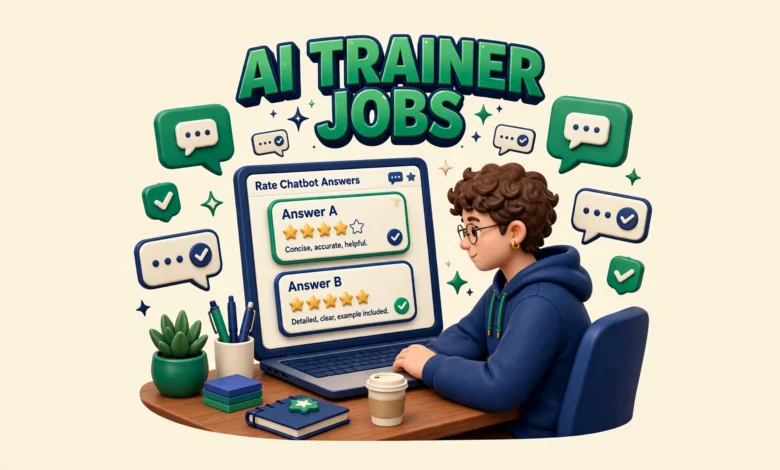
Behind every polished chatbot answer is a human trainer who read drafts, ranked them, corrected mistakes, and explained what a better answer would look like. That work is called RLHF, short for reinforcement learning from human feedback. In 2026, it is one of the most accessible remote jobs for people with strong language skills, even with no coding background and no tech degree.
Here is the honest truth up front. RLHF trainer jobs are real and they do pay, but they are not the easy money some social media posts promise. Pay varies by skill level, projects stop without warning, and hiring includes unpaid assessments many applicants fail. With realistic expectations, it can be good remote income.
What is RLHF in plain words?
RLHF is a training method where humans teach an AI model what a good answer looks like. A chatbot learns language patterns from huge amounts of text, but that alone does not teach it to be helpful, accurate, or safe. It needs human judgment to learn the difference between a great answer and a mediocre one.
Take a simple example. A user asks how to fix a leaking tap. The model drafts two answers. One is clear, step by step, and warns about turning off the water supply first, the other vague and skipping a safety step. A trainer ranks the first higher and notes why. Multiplied by millions of examples, the model learns to prefer clear, safe, accurate answers. You are not writing code. You are the human judgment shaping how the model behaves.
What does an RLHF AI trainer actually do all day?
- Ranking and rating responses: read two or more chatbot answers to the same prompt and rank them best to worst, or rate one answer on helpfulness, accuracy, and tone.
- Writing justifications: after ranking, explain your choice in a few sentences. Vague notes like “this one is better” get rejected. Point to specific strengths and weaknesses.
- Rewriting answers: turn a weak response into the answer an expert would give.
- Red teaming: deliberately try to get the chatbot to produce harmful, biased, or incorrect answers, then document how it failed.
- Prompt creation: write realistic user prompts, including tricky or ambiguous ones, so the model can be tested on questions real users actually ask.
- Fact checking and annotation: verify claims, label parts of a response, or categorize errors.
Who hires RLHF trainers?
Most trainers are hired through specialist platforms, not directly by AI companies, and they work as independent contractors, not employees. The biggest names in 2026 are worth knowing, because most legitimate opportunities flow through them.
- Outlier: one of the largest trainer platforms, with projects in many languages and subjects.
- DataAnnotation: a popular platform for general and expert tasks, known for strict quality standards.
- Mercor: a platform matching experts with AI labs, often for higher paying specialist roles in law, medicine, coding, and finance.
- Alignerr: a training platform connected to the data company Labelbox, with projects that often involve evaluation and reasoning tasks.
- Surge AI: a data annotation company hiring contractors for labeling, evaluation, and language tasks, including some RLHF style work.
- OpenTrain: a newer platform focused on AI training tasks. It is smaller than the names above, so project availability may be thinner.
Availability depends on your language, location, and expertise. English trainers face the largest pool and the most competition, while speakers of other major languages or people with real expertise in accounting, medicine, or programming often face less competition. Start with the biggest platforms: Outlier and DataAnnotation are the two most commonly cited starting points, and our guide to the best platforms for AI training jobs compares them in more detail.
How much do RLHF trainer jobs really pay?
Pay is where honest reporting matters most. You will see screenshots claiming $70 per hour or more, and job boards listing medians in that range. Those figures are real for some roles, but they reflect expert work, not beginner work.
General rating and ranking work, the entry level for most beginners, typically pays roughly $15 to $20 per hour on major platforms. Intermediate work that requires strong writing, such as rewriting answers or writing detailed justifications, usually pays more than simple rating. Expert projects, where you need a degree or professional experience in a field like law, medicine, engineering, or software development, pay substantially more. Some expert roles are quoted at $40 to $70 per hour or beyond, but those rates go to people with verified credentials, not general applicants. For a fuller breakdown, see our guide on how much AI training jobs pay by country.
Some platforms pay per task rather than per hour, so estimate your real hourly rate in your first week. Also remember this is contract work with no benefits: no paid leave, no health insurance, and no guaranteed hours. You are paid only for work you complete.
How do you get hired as an RLHF trainer?
- Apply with your real details: fill in education and work history honestly, and list your languages and subject expertise. Exaggerated claims backfire, because expert projects verify credentials.
- Complete a screening assessment: usually a short, unpaid test of reading comprehension, reasoning, and following instructions. It filters out a large share of applicants.
- Pass a project specific qualification: a longer, usually unpaid assessment tied to a real project type, such as ranking sample responses against a guideline document. Most rejections happen here.
- Onboard and start on trial: successful applicants begin with a small batch of tasks under closer quality review. Early scores decide whether you keep getting work.
- Build a track record: consistent quality over weeks unlocks more projects and sometimes higher paying ones. Reliability matters as much as skill.
How do you pass the assessments?
- Read the guidelines fully before starting: most tasks test whether you followed a specific rule buried in the guidelines, such as how to handle partially correct answers. Skimming them is the single most common failure.
- Choose accuracy over speed: assessments are not timed races. A careful answer beats a fast one that misses the point. Speed comes later, once the task type is familiar.
- Practice ranking before you apply: take two chatbot answers to the same question and practice ranking them with written reasons. If you cannot explain your ranking clearly, the assessment will expose that.
- Write specific justifications: name the exact sentence that was wrong, the fact that was missing, or the tone problem that hurt the answer.
- Follow the format exactly: if the task asks for a ranking plus a two sentence justification, give exactly that.
- Do not use AI tools to complete assessments: platforms check for this, and getting caught can mean a permanent ban.
For a detailed walkthrough of one platform’s process and its common rejection mistakes, see our guide on how to pass the DataAnnotation assessment. Much of that advice applies to other platforms too, because the underlying skills are the same.
What are the downsides nobody mentions?
The biggest downside is feast or famine. Projects have a start and an end, and when a project ends, your income from it ends too. You may wait weeks for the next suitable project. Trainers who rely on a single platform feel this hardest. Having two or three platforms active softens the gaps, but it does not remove them.
Quality reviews can also be stressful: work is sampled and scored, and low scores can mean removal with little warning. Some tasks are mentally draining too. Red teaming can expose you to disturbing content, and long ranking sessions demand intense concentration. Take breaks, because tired work fails quality checks anyway.
How do you get paid in Pakistan or India?
Most major platforms pay through PayPal, Payoneer, or similar services, and the right choice depends on where you live. PayPal is the most commonly offered method, but its limits matter. In Pakistan, PayPal does not offer full local accounts, so many Pakistani freelancers receive payments through Payoneer or through a PayPal account held in another jurisdiction, which carries its own risks and fees. In India, PayPal works for receiving payments but with restrictions on holding balances and on allowed purposes, so check the current rules before relying on it.
Payoneer is widely used by freelancers in both countries, supports bank withdrawals to local accounts, and is accepted by several trainer platforms. AirTM is another option for moving money between services, though fees vary. Before your first payout, check whether your platform supports your method, what fees and exchange rates will cost, and how long transfers take. A method that eats 10 percent in fees is a pay cut you did not agree to. Keep records for tax purposes too, since contract income is still income.
How do you spot an RLHF job scam?
- Legit platforms never charge applicants: no registration fee, no training fee, no deposit, and no payment to unlock tasks. Any job that asks you to pay first is a scam, full stop.
- Recruitment happens on official platforms, not messaging apps: if someone recruits you only through Telegram or WhatsApp, walk away.
- Unrealistic pay promises are a red flag: thousands of dollars per week for simple rating work, with no assessment and no experience required, is designed to hook you, not hire you.
- Early requests for sensitive information are suspicious: a real platform asks for payment details only after acceptance and onboarding, through its own secure system, never through a chat message.
- Check the domain: scammers imitate real platform names with lookalike domains. Navigate to a platform yourself rather than clicking a link sent by a stranger.
What are the most common questions about RLHF trainer jobs?
Do I need a degree to become an RLHF AI trainer?
No degree is required for general rating and ranking work, where strong language skills and careful reasoning matter most. Expert projects typically require a degree or professional experience in a field like medicine, law, or software engineering, and pay more for it.
How long does it take to get hired?
It varies a lot. Screening and assessment can take days or weeks, and project matching after acceptance can take longer. Some applicants start paid work within weeks, others wait months. Applying to more than one platform improves your odds, but there is no guaranteed timeline.
Can I do RLHF training part time?
Yes, and many trainers do. Most platforms let you choose your hours within project deadlines, which makes the work compatible with study or another job. The trade off is fewer tasks on limited volume projects. Consistency still matters: regular availability beats occasional bursts.
Are RLHF trainer jobs a scam?
Real RLHF trainer jobs exist at well known platforms such as Outlier, DataAnnotation, and Mercor, but scams imitating them are common. The dividing line is simple: legitimate platforms never charge applicants, recruit through their official websites, and require assessments before paid work. Any offer that asks for payment, recruits only via Telegram or WhatsApp, or promises huge pay with no assessment is a scam.
Last updated: November 2026.