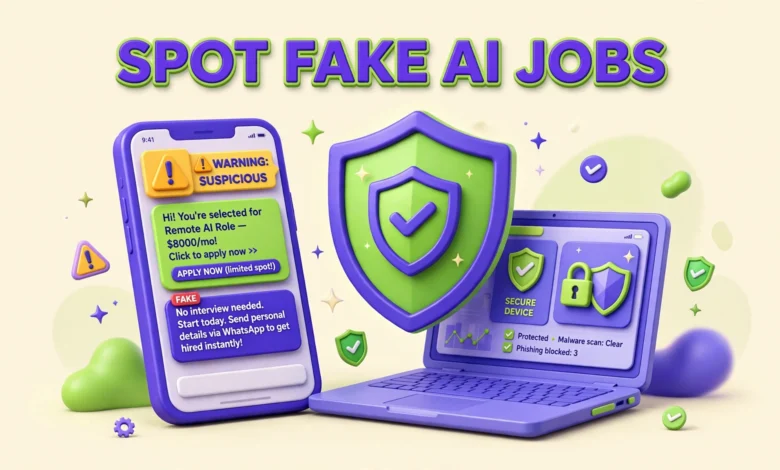
AI training jobs sound almost too convenient: work from home, no experience needed, get paid to label images, rate chatbot answers or record short videos. That convenience is exactly why scammers love them. Every week, beginners receive convincing job offers on WhatsApp, Telegram and Instagram that promise easy money, then quietly drain fees, deposits or bank details from the people who can least afford to lose them.
This guide explains how to spot fake AI training job offers before you pay anything or share sensitive information. You will learn the most common scam patterns, including upfront fees, crypto deposits, cheque tricks and fake equipment vendors, and you will learn how legitimate platforms actually hire, test and pay. It also gives honest pay ranges by region, because vague promises of huge daily income are often the first warning sign.
Why Scammers Love AI Training Jobs Right Now
Real AI training work does exist. Companies need humans to label data, check AI responses, record speech, and test models. Because much of that work can be done remotely, and because many tasks genuinely do not require a degree, the field attracts students, stay at home parents, freelancers and job seekers in Pakistan, India and many other countries. Scammers exploit that hope by copying the language of real platforms while removing every safeguard real platforms use.
The scam usually starts with urgency and flattery. You are told you were selected, shortlisted or specially recommended, even though you never applied. The recruiter may use a stolen company logo, a professional looking profile photo, or a fake employee ID. The job sounds simple, the pay sounds generous, and the start date is immediate. That combination is designed to make you act before you check. A real hiring process is slower, more boring and more specific, and that difference is your protection.
Red Flag 1: An Offer You Never Applied For
Unsolicited offers on WhatsApp or Telegram are the most common entry point. A stranger messages you about an AI data job, often claiming to represent a well known platform, and moves the conversation off the official website as fast as possible. They may ask you to join a private group, download an unfamiliar app, or complete tasks through a chat bot rather than a real work dashboard.
Legitimate platforms do not recruit this way. They post roles on their own official websites, ask you to create an account there, and communicate through that platform or a company email domain, not a personal WhatsApp number with no verifiable identity. If someone offers you a job in the first message, treat it as suspicious until you verify the company independently, by visiting its official site yourself rather than clicking a link the recruiter sent.
A similar version uses social media comments and direct messages. Someone replies to your post offering a side income opportunity and may show payment screenshots. Screenshots are easy to fake, so payment proof from a stranger proves nothing about the job offered to you.
Red Flag 2: Any Upfront Fee, Deposit Or Purchase
The standing rule is simple and non negotiable: legitimate AI training platforms never charge applicants. They do not ask for a registration fee, a training fee, a refundable deposit, a tax payment before your first payout, or a fee to unlock higher paying tasks. If payment flows from you to the employer before you have earned anything, it is almost certainly a scam, no matter how professional the explanation sounds.
Scammers dress this fee up in many ways. It may be called an account activation charge, a security deposit, a course fee for mandatory training, or a wallet top up. The fee may start small, then grow larger once you are invested, which makes it harder to walk away.
- Registration, training or activation fees charged before any work begins.
- Deposits to unlock tasks, withdraw earnings or upgrade your account level.
- Payments for certificates, ID cards or starter kits that real platforms provide free.
- Requests to pay through gift cards, crypto, or personal bank transfer to an individual, not a company.
- Pressure to pay immediately, with warnings that your spot will be given to someone else.
Red Flag 3: Crypto Deposits, Cheques And Money Mule Tricks
Crypto deposit scams are especially dangerous because payments are hard to reverse. A common pattern asks you to deposit crypto into a wallet to activate tasks, complete fake trading or rating tasks, and watch a dashboard balance grow. When you try to withdraw, a new fee appears, then another, and the balance never actually reaches you. The dashboard was never connected to real money. It was a display designed to keep you depositing.
Cheque and money mule tricks work differently but are just as harmful. A scammer sends you a cheque or transfer that later bounces, and asks you to forward part of it, buy gift cards, or send crypto before the original payment clears. You are left liable when the bank reverses the transaction. Receiving payments into your own account and passing them on for a commission is money laundering, even if the recruiter calls it payment processing, and it can lead to a frozen account or legal trouble.
Never let an employer use your bank account, crypto wallet or payment app as a pass through for other people’s money. Legitimate platforms pay you for completed work through their own payroll or payment partners. They never ask you to forward funds or process refunds on their behalf.
Red Flag 4: Fake Equipment Vendors And Vague Pay Promises
Some scams do not ask for a fee directly. Instead, they tell you that you must buy specific equipment, software or a headset from their approved vendor before you can start. The vendor is controlled by the scammers, the price is inflated, and the job disappears after you pay. Real platforms may list recommended equipment, such as a decent microphone or a quiet workspace, but they do not force you to buy from one secret supplier as a condition of employment.
Vague pay promises are another major warning sign. Scam offers often promise a fixed high daily income with no mention of task availability, pay per task, quality review or rejection rates. They may say you will earn 5000 rupees per day or 100 dollars per day with only two hours of work, without explaining how pay is calculated. Real AI work is usually paid per task, per hour of reviewed work, or per completed project, and earnings vary with task supply and your accuracy.
As a rough honest guide, entry level data annotation and rating work commonly pays a few dollars per hour in many regions, with higher rates for specialised languages, technical expertise or long projects. Workers in the United States, United Kingdom and Western Europe often see higher hourly ranges, while workers in Pakistan, India and similar markets often see lower ranges. Some experienced annotators earn more, but feast or famine availability is normal. A platform that guarantees a high fixed income to every beginner, with no assessment and no task limits, is not describing real AI work.
How Legitimate Platforms Actually Hire And Pay
Real platforms follow a recognisable pattern. You apply on the official website, not through a chat message. You create an account, complete a profile, and often take a screening assessment that tests your language skills, attention to detail or ability to follow guidelines. That assessment may be unpaid, which is a genuine drawback to be aware of, but it is not a fee. You are giving time, not money, and you should never be asked to pay to take it.
After acceptance, you usually complete onboarding, read project guidelines, and start with a limited set of tasks while your work is quality checked. Pay terms are written down before you work: the rate, payment method, payment schedule, and rules for rejected work. Payments typically go through established methods such as PayPal, Payoneer or bank transfer, depending on your country, and arrive on a stated cycle, not instantly after every task. If any details are missing or only explained verbally in a chat, ask for them in writing before you start.
For an overview of platforms that follow this model, see our guide to the best platforms for AI training jobs. If you are preparing for a screening test, our guide on how to pass the DataAnnotation assessment explains what assessors look for, and our Outlier AI review examines one well known platform in detail. Check the official sites directly, such as DataAnnotation and Outlier, rather than trusting links sent by a recruiter.
Honest Caveats: Unpaid Tests And Feast Or Famine Work
Even legitimate AI training work has downsides that scam offers hide. Assessments can take hours and still end in rejection, with no payment for that time. Task supply can disappear for weeks after a busy period. Quality reviews can reject work you thought was correct, and pay can be delayed by review cycles. Some projects end without warning when a client changes direction. None of this makes a platform a scam, but AI training work is rarely the stable, guaranteed income that scam ads promise.
Treat AI training work as flexible side income first, and build up slowly. Start with one reputable platform, learn its guidelines, and track your real hourly earnings after rejections. Only expand once you understand the rhythm and the task supply.
What To Do If You Already Replied, Paid Or Shared Details
If you only replied to a suspicious message, stop engaging, do not click further links, and block and report the account where it contacted you. Do not argue with the scammer or try to recover money by sending more money. If you shared a password, change it immediately, and turn on two factor authentication on that account and on your email. If you shared ID documents, monitor your accounts closely and consider reporting the incident to your local cybercrime reporting channel.
If you paid, contact your bank or payment provider right away and ask whether the transaction can be disputed or reversed. Crypto payments are much harder to recover, but still report the wallet address and conversation to the platform and to authorities, because reports help others even when recovery is unlikely. Save screenshots of the offer, payment receipts and chat history before you block the account. The rule that protects you next time is simple: if a platform charges applicants, demands a deposit, or asks you to move money for others, it fails the test, no matter how polished the offer looks.
Frequently Asked Questions
Do real AI training platforms ever charge a registration fee?
No. Legitimate platforms earn money from their clients, not from applicants. Any registration, training, activation or deposit fee is a strong scam signal, even if it is described as refundable.
Is an unpaid assessment a scam?
Not necessarily. Many real platforms use unpaid screening assessments to test skills before offering paid work. The difference is that a real assessment costs time, not money, and it happens on the official platform after you apply there yourself.
How much can beginners realistically earn from AI training jobs?
It varies widely by task type, language, region and availability. Many beginners earn only a few dollars per hour, and earnings can be irregular. Be suspicious of any offer that guarantees a high fixed daily income to every new worker.
What should I do if a recruiter contacts me on WhatsApp about an AI job?
Do not apply through the chat link. Search for the company yourself, visit its official website directly, and apply there if the role is genuinely listed. If you cannot verify the recruiter or the role independently, treat the offer as unsafe and report it.
Last updated: October 2026.