

If you have spent any time in creator circles this year, you have heard both sides shouted at you. One guru says Reels are the only thing that matters and carousels are dead. Another insists carousels are the secret engagement hack and Reels are oversaturated. They cannot both be right, and honestly, neither of them is.
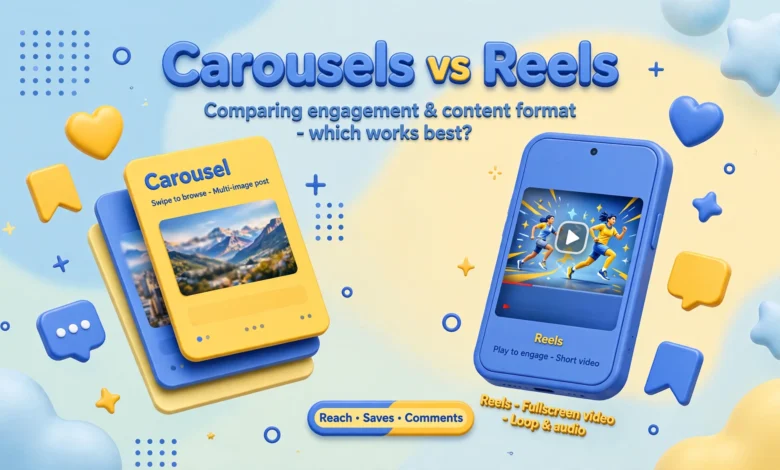
Here is the boring but useful truth: carousels and Reels are judged by Instagram on different signals, and they do different jobs for your account. Reels are the discovery engine. Carousels are the trust and depth engine. Asking which one “wins” is like asking whether a fisherman needs a net or a rod. It depends on what he is fishing for.
This guide breaks down the 2026 benchmark data, explains what each format actually does well, and gives you a practical posting mix instead of another hot take. If you are building a full Instagram strategy from scratch, pair this with our grow on Instagram in 30 days walkthrough, which covers the fundamentals this post builds on.
Which Format Gets More Reach?
Reach is the one metric where Reels clearly dominate. Buffer’s 2026 analysis found that Reels get notably more reach than carousels, and that gap has been consistent across multiple studies over the past few years. The reason is structural: Instagram’s recommendation engine is built to push Reels to non-followers, while carousels are distributed more heavily to your existing audience.
Think of it this way. Reels are Instagram’s billboard on the highway. Carousels are the conversation in your living room. If your goal is raw exposure, new eyes, and follower growth, Reels are the better vehicle. Data from several social media studies consistently shows Reels reaching a larger share of non-followers than any static format.
But there is a caveat the gurus skip. More reach does not automatically mean more value. A Reel that reaches 50,000 strangers and converts 200 of them into followers did something useful. A Reel that reaches 50,000 strangers and gets 3-second views and zero profile visits just inflated your vanity metrics. Reach is only step one. What people do after they see your content is where carousels strike back.
One more honest note about benchmarks before we go further. These reports measure different things with different denominators. Some use engagement per post, some use engagement per follower, some use engagement per reach. So when Buffer says Reels lead on reach while another study highlights carousel engagement, they are not contradicting each other. They are measuring different races. Always check what the denominator is before quoting a stat.
Which Format Gets More Engagement?
This is where it gets interesting, and where the “Reels are everything” crowd has to sit down. Buffer’s 2026 analysis found that while Reels win on reach, carousels drive far more engagement per person reached. That is the key phrase: per person reached. A carousel shows to fewer people but works harder on the people it reaches.
Socialinsider’s 2026 benchmark added weight to the same conclusion, putting carousels slightly ahead on engagement rate overall. This has been a durable pattern for years now. Carousels generate more likes, more comments, and more shares per viewer than Reels do, largely because swiping through multiple slides is itself a form of engagement that the algorithm notices.
Every swipe is a signal. When someone flips through seven slides, Instagram reads that as genuine interest, the kind that makes the algorithm show your next post to them sooner. A Reel viewer who watches four seconds and scrolls past sends a much weaker signal. So if you measure success by comments, conversations, and community building, carousels are arguably the stronger format.
For context, our breakdown of the Instagram Reels algorithm in 2026 explains exactly which signals Reels are optimized for, so you can see how the two formats complement rather than compete.
Which Format Gets More Saves?
Carousels win this one and it is not close. Metricool’s research found that carousels earn far more saves than single images, and the pattern holds against Reels too. Saves are one of the heaviest ranking signals Instagram has, because saving is a private vote that says “I will come back to this.”
Why do carousels get saved so much? Because they are the natural home of save-worthy content: step-by-step tutorials, lists, checklists, frameworks, before-and-after breakdowns. A carousel can hold a mini guide. A Reel can too, but viewers have to rewatch or screenshot it, which is friction. A carousel sits in their saved folder as a readable reference.
Saves also feed a quiet but powerful mechanic that Reels do not have. When someone scrolls past your carousel without opening it, Instagram often shows it to them again later, this time opened on slide two. That second chance does not exist for Reels. It is one of the reasons carousels have such strong effective reach per post even though their initial reach numbers look smaller.
Practical takeaway: if you want saves, make carousels that function as reference material. Tips that people will want later, processes they might copy, data they might quote. The first slide hooks them, but slides 3 through 8 are what earn the save. And since saved content keeps working for you in people’s collections, it compounds in a way a viral Reel often does not.
So Which One Should You Actually Post?
Both. The real question is the ratio, and that depends on your current goal. Here is the mix that works for most accounts in 2026:
- 1 to 2 Reels per week for discovery. These are your new-follower engine. Keep them short, hook in the first two seconds, and make them understandable without sound for maximum shareability.
- 1 to 3 carousels per week for depth. These build trust with your existing audience, earn saves and comments, and give people a reason to follow you rather than just watch you.
- Skip single images as a strategy. Single-image posts have collapsed in reach and engagement across every 2026 benchmark. Post them only if the image itself is the point, like photography portfolios. Otherwise both formats beat them.
If you are brand new and have almost no followers, lean slightly toward Reels, because you need discovery more than depth right now. If you already have a few thousand followers but engagement feels flat, lean toward carousels, because your existing audience is an asset you are underusing. Adjust the ratio quarterly based on what your own insights tell you, not based on what a benchmark said about someone else’s account.
This hybrid logic applies beyond Instagram. Many creators cross-post their Reels as YouTube Shorts and TikToks, and the comparison logic in our brand deals with small followers guide shows why a smaller but deeply engaged audience can actually earn more than a large passive one.
How Do You Make a Carousel That Actually Performs?
A bad carousel flops harder than a bad Reel, because it asks more of the viewer. If slide one does not earn the swipe, slides two through ten do not exist. Here are the practices that consistently show up in high-performing carousels:
- Hook slide with a clear promise. State the outcome, not the topic. “5 email scripts that got me replies” beats “Email marketing tips.” The reader should know exactly what they get for swiping.
- 5 to 10 slides is the sweet spot. Too few and there is nothing to save. Too many and completion rates fall off a cliff. Most viral carousels land between 7 and 8 slides.
- One idea per slide. Dense slides get skipped. Give each point its own card with breathing room, and let the swipe rhythm carry the reader forward.
- Make at least half the content save-worthy. Actionable steps, templates, numbers, checklists. Entertainment carousels can work, but utility carousels get saved, and saves are the signal that matters most.
- End with a soft CTA. Ask a question, invite the save explicitly, or point to a related post. Carousels already generate comments well, so a light nudge is enough.
One design note that matters more than people think: keep text readable on small screens. Slides are viewed on phones, often quickly. If someone has to pinch to zoom, you have lost them. Also make sure your first slide works as a standalone image, because that is what shows up in the grid and in the re-serve to people who skipped it.
If you want your captions to work as hard as your slides, our guide to Instagram SEO with keywords in captions explains how searchable captions can pull in discovery traffic for both formats.
What Are the Honest Caveats Nobody Mentions?
Before you reorganize your whole content calendar around these numbers, a few honest caveats:
- Benchmarks describe averages, not your account. A study of 5 million posts tells you about the platform, not about your niche. A fitness coach and a B2B consultant will see wildly different results from the same formats. Your own insights are the only benchmark that truly matters.
- Exact numbers shift constantly. Instagram tweaks distribution every few months. A study published in January can be stale by October. Treat the directional patterns as durable (Reels = reach, carousels = depth) and treat specific percentages as snapshots with an expiry date.
- Format quality beats format choice. A great single idea expressed as a carousel will outperform a lazy Reel every time. The creators who obsess over “which format” while posting mediocre content are optimizing the wrong variable.
- Watch time still rules Reels. A Reel only gets that reach advantage if people actually watch it. A 30-second Reel with a 4-second average watch time will be buried. Keep Reels tight, front-load the hook, and cut ruthlessly.
The guru version of this topic is “post X and go viral.” The honest version is that both formats are tools with known strengths, and the creators who win are the ones who use each for what it is good at. Instagram’s own creator resources are worth checking periodically too, since the platform occasionally publishes guidance on what it is currently prioritizing.
Frequently Asked Questions
Are carousels dead in 2026?
No, and the data says the opposite. Multiple 2026 benchmarks put carousels ahead of Reels on engagement rate and saves, and the re-serve mechanic gives them a second distribution chance that Reels lack. What is dead is the low-effort carousel: five slides of generic quotes will not perform in any year.
Can you turn a carousel into a Reel?
Yes, and it is a smart repurposing move. Animate your carousel slides into a short slideshow-style Reel with music, and you get discovery reach on content you already made. Just keep it under 15 seconds and make sure the text is readable at video speed, because viewers cannot pause to read the way carousel swipers can. Instagram’s help center has current specs for Reels dimensions if you want to get the export right.
How many carousels and Reels should a small account post per week?
A sustainable starting mix is 1 to 2 Reels and 1 to 3 carousels per week. Consistency beats volume at small sizes, so pick a cadence you can maintain for months. One excellent carousel per week outperforms three rushed ones, and the same is true for Reels.
Do carousels or Reels make more money for creators?
Indirectly, carousels often contribute more to revenue per follower because they build the trust that sells: saves, DMs, and comments are where buying intent shows up. Reels contribute by growing the audience that carousels then convert. Neither format pays you directly on Instagram in most cases, so think of Reels as the top of your funnel and carousels as the middle.
Last updated: October 2026.