


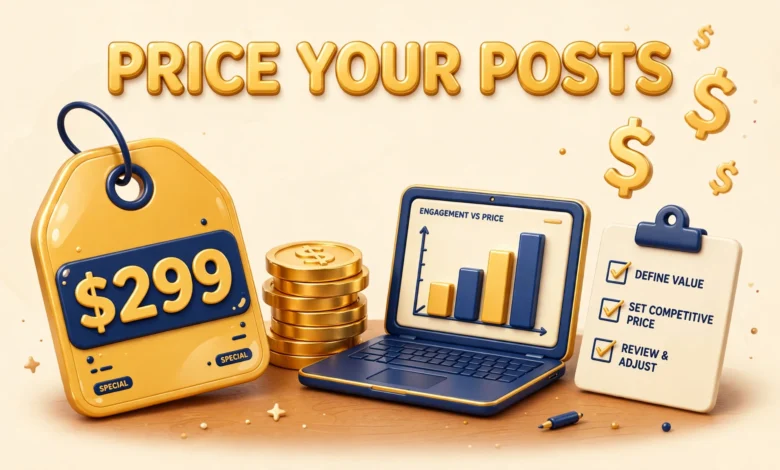
Pricing a sponsored post feels harder than making the post itself. A brand emails you, you feel excited, and then the hard question arrives: how much should I charge? Charge too little and you work for almost nothing. Charge too much and the brand disappears.
Most small creator deals are modest. Rate guides online often show big numbers that belong to large accounts, not to someone with 2,000 or 8,000 followers. That does not mean small creators cannot earn from sponsored posts.
This guide uses real deal data from 2025 and 2026, explains how to price sponsored posts as a small creator, and shows how to add fair charges for usage rights and exclusivity.
What do small creators actually get paid for sponsored posts?
OpenSponsorship data on 1,527 paid deals from January 2025 to June 2026 gives a useful starting point. The median payment was $134 per deliverable for creators under 10,000 followers. For micro creators with 10,000 to 50,000 followers, the median was $150. Mid-tier creators earned a median of $417, macro creators earned $517, and mega creators earned $2,727.
The jump from under 10,000 followers to 10,000 to 50,000 followers is small. Follower count alone does not double your price. What matters more is how many people actually watch your content and whether your audience matches the brand.
Collabstr analysed more than 21,000 collaborations and found that 80 percent cost under $300. That fits the OpenSponsorship picture. Most deals are small. A $500 or $1,000 deal is possible for a small creator, but it is not the normal starting point.
The median cost per view for nano creators is about $0.13. That figure is useful because it shifts the conversation from followers to views. A creator with 5,000 followers and 4,000 average views can be worth more than a creator with 20,000 followers and 1,500 average views.
Why the $100 per 10,000 followers rule is misleading
You may have seen the rule that says charge $100 for every 10,000 followers. It sounds simple and it is easy to remember. The problem is that it has no data behind it. It is folk wisdom that has been repeated so often that it feels like a fact.
Under that rule, a creator with 5,000 followers would charge $50. That may be fair for a simple story, but it may be far too low for a well made reel that takes three hours to film and edit and reaches 10,000 people.
Followers are a weak signal. Some followers are inactive, some followed years ago and never see your posts, and some came from one viral post and never engaged again. Views, saves, shares, and comments tell a much better story.
That is why this guide prices on views, not followers. It is fairer for you and clearer for the brand. You can show your numbers, explain your method, and defend your price without guessing.
How to price sponsored posts in three simple steps
Use this method every time a brand asks for a rate. It takes ten minutes, and it gives you a number you can explain in one sentence.
Step 1: Find your median views for that format
Open your last 10 posts in the format the brand wants. If they want a reel, use your last 10 reels. Do not mix formats, because reels, stories, and carousels reach very different numbers of people.
Write down the view count for each post, sort the numbers, and take the middle value. That is your median. The median is better than the average because one viral post will not inflate it, and one poor post will not drag it down.
Step 2: Calculate your reach price
Multiply your median views by $0.13, the median cost per view for nano creators. If your median is 2,950 views, that gives about $384. That may look high next to the $134 median for creators under 10,000 followers, and that gap is useful information about your reach and your niche.
Do not treat $0.13 as a fixed price. It is a benchmark. If your audience is in a high value niche like finance or software, brands may pay more. If your audience is broad and hard to target, brands may pay less.
Step 3: Set your production floor and take the higher number
Your production floor is the lowest price that makes the work worth doing. Calculate it as your hours times your freelance hourly rate, plus your costs. If a reel takes four hours, your hourly rate is $25, and you spend $20 on props or travel, your floor is $120.
Take the higher of your floor and your reach price as your base rate. This protects you in two directions. When your reach is strong, you do not sell it cheaply. When your reach is still growing, you do not work for less than your time is worth.
For a clear walkthrough of real rate examples and negotiation scripts, see this guide on how much to charge for a sponsored post.
What about YouTube sponsored integrations?
YouTube works differently from Instagram or TikTok because videos live longer and search traffic keeps bringing new viewers. ThoughtLeaders data from April 2026 puts YouTube sponsored integrations at about $20 to $60 per 1,000 average views.
Use the same method. Take the median views of your last 10 videos, not your best video. A 60 second mid-roll mention is worth more than a 15 second pre-roll mention, and a dedicated video is worth more than either.
Do not copy Instagram rates onto YouTube, or YouTube rates onto Instagram. The platforms have different lifespans, production costs, and audience behaviour. Price each format on its own numbers.
How to charge for usage rights and exclusivity
Your base rate covers one post on your own account. It does not automatically cover the brand reusing your content in their ads, on their website, or in a shop display. Usage rights are a separate charge, and you should price them separately in every quote.
Usage rights are typically charged at an extra 20 to 50 percent of the base rate. Data from impact.com shows a wide range by creator size. Nano creators often charge 0 to 50 percent per month, while micro creators often charge 25 to 75 percent.
Always put usage in writing. State the platforms, the time period, and whether paid ads are included. A 30 day licence for organic use on the brand Instagram account is very different from a 12 month licence for paid ads across several platforms.
Exclusivity is also a separate charge. If a brand asks you not to work with any competitor for 30, 60, or 90 days, you are giving up other income. Exclusivity typically costs 20 to 100 percent of the base rate, depending on how broad the category is and how long the block lasts.
Do not agree to exclusivity for free, and do not agree to open ended exclusivity. If the brand wants a long block, the fee should reflect the deals you will have to turn down.
What to do when a brand offers free products instead of money
Gifted products are common for small creators. Sometimes a gift is a fair trade. If a brand sends a $120 product and asks for one story that takes 20 minutes, the exchange may be reasonable. If the same brand asks for three reels and a month of usage rights for the same product, it is not.
Ask yourself three questions before you accept a gifted deal. Would you buy this product yourself? Does the work take less time than the product is worth? Will this post help your audience? If the answer to any question is no, ask for payment or decline politely.
The FTC requires clear disclosure of any paid relationship, including gifted products. If a brand sent you something for free in exchange for a post, you must say so clearly. Use plain language at the start, such as Gifted by a brand name, and use the platform paid partnership label where it is available.
Disclosure protects your audience and your account. Followers can tell when a recommendation is honest, and they lose trust fast when they feel misled. Brands also prefer creators who disclose properly, because it keeps the brand safe too.
How to negotiate without losing the deal
Most brands expect some negotiation. A first offer is often a starting point, not a final price. If a brand offers less than your base rate, reply with your number, your reason, and one flexible option.
- Share your median views and your production time so the brand can see the value.
- Offer a smaller package, such as one story instead of a reel plus stories, if the budget is fixed.
- Ask what the budget range is before you drop your price, so you do not negotiate against yourself.
- Trade a lower fee for a shorter usage licence or no exclusivity, not for more work.
- Keep the tone polite and professional, even when the offer is far too low.
If you are still under 10,000 followers, read this practical guide on brand deals under 10k followers for realistic expectations and outreach tips that fit small accounts.
You can also learn from related Creator Growth guides on this site. Read how to get brand deals with small followers and how to make money as a small creator in 2026. Growing your reach first also helps your rates, so our grow on Instagram in 30 days plan is a useful place to start.
Why sponsored posts should not be your only income
Sponsored posts are unpredictable. Brands pause budgets, algorithms change, and a good month can be followed by two quiet months. If sponsored posts are your only income, every slow month feels like a crisis.
Small creators do better when sponsored posts sit beside other income. Affiliate links, digital products, a small service, or platform payouts can smooth out the gaps between brand deals. That mix also gives you more power in negotiation, because you can turn down bad deals.
Think of sponsored posts as one income stream, not a salary. Price them fairly, deliver good work, and keep records of what you charged. Over time, your rates will rise with your median views and your reputation for reliable delivery.
Frequently asked questions
How much should a small creator charge for a sponsored Instagram post?
Start with your numbers, not a guess. OpenSponsorship data puts the median at $134 per deliverable for creators under 10,000 followers, and Collabstr found that 80 percent of collaborations cost under $300. Use your median views from your last 10 posts in that format, apply the $0.13 cost per view benchmark, set your production floor, and take the higher number as your base rate.
Should I price sponsored posts on followers or views?
Price on views. Followers include inactive accounts and people who never see your posts, while views show how many people actually watched the format you are selling. Use the median views of your last 10 posts in that format.
How much extra should I charge for usage rights and exclusivity?
Usage rights are typically an extra 20 to 50 percent of your base rate, with impact.com data showing nano creators at 0 to 50 percent per month and micro creators at 25 to 75 percent. Exclusivity typically costs 20 to 100 percent of the base rate. Always state the platforms, the time period, and whether paid ads are included.
Do I need to disclose gifted products in a sponsored post?
Yes. The FTC requires clear disclosure of any paid relationship, including gifted products. Say clearly at the start of the post that the product was gifted or that the post is a paid partnership, and use the platform paid partnership label where it is available.
Last updated: November 2026.


One Comment