AI model evaluator jobs are one of the most realistic ways for a beginner to earn online in 2026 without a degree in machine learning, without coding, and without an existing audience. Companies that build chatbots and AI assistants need real people to read AI answers, judge whether they are correct, helpful, and safe, and explain where they went wrong. That human judgment is the job, and demand for it keeps growing as AI tools spread into every industry.
This is not a get rich quick scheme. The work is contract based, the pay varies by project, and some weeks are quiet. But for someone with strong English, clear writing, and good attention to detail, it is a genuine entry point into the AI economy. This guide explains exactly what the work involves, what it pays, where to find it, how assessments work, and how to start in the next 30 days.
What Does an AI Model Evaluator Do?
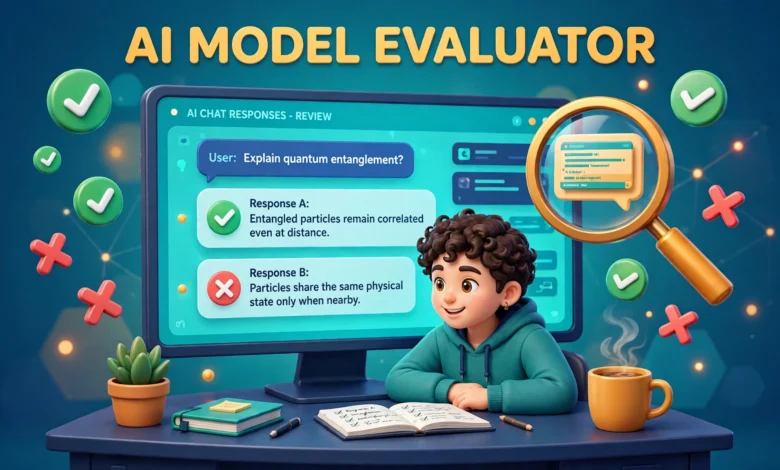
An AI model evaluator tests and rates the outputs of an AI system. You are given a prompt and two or more AI responses to that prompt. You compare them, pick the better one, and explain your choice. In other tasks you grade a single answer on accuracy, tone, completeness, and safety, or you try to break the model with tricky prompts to find its weaknesses.
A typical task looks like this. The prompt asks the AI to explain photosynthesis to a 12 year old. Response A gives a clear, simple explanation with a good example. Response B is technically correct but uses university level language and includes one wrong fact about chlorophyll. Your job is to choose Response A, note the reading level problem in Response B, and flag the factual error. That feedback helps trainers improve the model.
Evaluator vs Data Annotator vs AI Trainer: What Is the Difference?
These three roles overlap, and job listings often mix the names, so it helps to know the distinction before you apply. A data annotator labels raw data so a model can learn from it. That means tagging images, transcribing audio, or marking parts of speech in sentences. The work is structured, repetitive, and usually lower paid.
An AI trainer creates training data and teaches the model by writing example conversations, ranking responses, and giving detailed feedback. An evaluator is closer to a trainer than to an annotator, but with more emphasis on testing and quality control. Evaluators often check work that trainers or other models produced, and they test finished models against real world prompts.
In practice, one platform may call the role an evaluator, another may call it an AI trainer, and a third may call it a rater or a specialist. Read the task description, not just the title. If the work is mostly comparing answers and writing reasons, it is evaluation work. If you want a deeper comparison of the two closest roles, read our guide on AI trainer vs data annotator before you choose a direction.
How Much Do AI Model Evaluator Jobs Pay?
Pay depends on the platform, the project, your location, and your skill level. Beginners on major platforms commonly earn 15 to 30 dollars per hour on active projects. That is the realistic starting range for general evaluation work in English. Specialists with a degree in law, medicine, engineering, or finance, or with strong coding skills, can earn 40 to 80 dollars per hour on expert projects.
Those hourly figures need context. Most evaluator work is project based and paid per task or per hour worked on that project. When a project ends, you wait for the next one. Some evaluators report busy months earning 1,500 to 2,500 dollars part time, followed by quiet weeks with little available work. That feast or famine pattern is normal in this field, so treat it as flexible income at first, not as a guaranteed salary.
For readers in Pakistan, payment usually arrives through Payoneer or Wise, since most platforms do not pay directly to local bank accounts. Set up a Payoneer or Wise account early, confirm your identity documents in advance, and check the withdrawal fee before you accept a project. A strong command of English is a real advantage here, because most high paying evaluation projects are in English, and clear written reasoning is exactly what clients are paying for.
Skills You Need to Get Started
You do not need a computer science degree. The core requirements are strong English reading and writing, clear reasoning, and careful attention to detail. You must be able to spot a subtle factual error, notice when an answer dodges the question, and explain your judgment in plain, logical sentences.
- Strong English: You read long answers quickly and write clear, grammatical explanations for your ratings.
- Attention to detail: You catch small errors in dates, numbers, names, and logic that a careless reader would miss.
- Clear writing: Your reasons are short, specific, and easy for a reviewer to follow.
- General knowledge: You can judge answers across everyday topics, from science and history to health, finance, and current affairs.
- Domain knowledge: A background in law, medicine, coding, maths, or finance opens higher paying expert projects.
- Reliability: You follow the project guidelines exactly, meet deadlines, and keep a steady quality score.
Where to Find AI Model Evaluator Jobs
Most evaluator work comes through a small group of well known platforms. Start with the largest ones, complete their assessments properly, and add a second or third platform later so a quiet period on one does not leave you with no work at all. Our roundup of the best platforms for AI training jobs covers several of these in more depth.
- DataAnnotation: One of the most popular starting points. Apply at https://www.dataannotation.tech/, complete the starter assessment, and qualify for projects that match your skills.
- Outlier: A large platform for AI training and evaluation work across many subjects. Visit https://outlier.ai/ and check which expert domains are open in your country.
- Mercor: Focuses on expert and professional talent, with higher rates for specialists in law, medicine, engineering, and coding.
- Alignerr: An AI training platform that hires evaluators and trainers for specialised projects, often with structured onboarding.
- Appen: A long running crowdsourcing company with rating, evaluation, and data projects in many languages. Visit https://www.appen.com/ to browse current roles.
- Prolific: Mainly a research study platform, but useful for paid AI and survey tasks that build your experience.
- Toloka and Remotasks: Useful for smaller tasks and for building a work history, though pay is usually lower than the specialist platforms above.
Apply to two platforms at first, not ten. Each application includes an assessment that takes real time and focus, and a rushed, sloppy assessment is the most common reason beginners are rejected. Pick the platform whose projects match your skills, prepare properly, and give it your full attention.
How Applications and Assessments Work
Almost every platform starts with a short application form asking about your education, work history, languages, and areas of expertise. Be honest and specific. Vague answers like good at everything do not help. List real subjects you can judge confidently, and mention any degree, certification, or work experience that proves it.
Next comes an assessment. This is a test version of the real work: you rate sample AI responses, compare two answers, write reasons for your choices, and sometimes complete a short writing task. The assessment checks your English, your judgment, and whether you follow instructions. Our guide on how to pass the DataAnnotation assessment walks through the format in detail, and the same principles apply on other platforms.
Common mistakes in assessments include rushing through tasks, giving reasons that are too vague, ignoring the project guidelines, and choosing the longer answer just because it looks more impressive. Take your time, read the guidelines twice, and write reasons that point to specific facts. If the guidelines say to prefer the answer that follows the instruction exactly, follow that rule even when the other answer sounds smarter.
A Realistic 30 Day Start Plan
Here is a practical plan for your first month. It assumes a few hours per day, not a full time commitment, and it focuses on getting qualified rather than chasing every platform at once.
- Days 1 to 3: Set up a Payoneer or Wise account, update your CV, and list your strongest subjects honestly. Read two platform homepages fully so you understand the work.
- Days 4 to 7: Apply to DataAnnotation and one other platform that fits your skills. Study their guidelines before you start the assessment.
- Days 8 to 14: Complete the assessments in a quiet block of time with no distractions. Review your answers before submitting.
- Days 15 to 21: While you wait for results, practise evaluation on your own. Take a question, generate two AI answers, compare them, and write a short reason for your pick.
- Days 22 to 30: Start your first project tasks slowly and carefully. Track your hourly rate per task, note which project types suit you, and apply to a third platform only after you are comfortable.
If you are also exploring other beginner friendly AI roles, our guide to prompt engineering jobs for beginners pairs well with evaluation work, and our 30 day plan at https://vutechgeek.com/grow-on-instagram-in-30-days/ shows how to grow an audience alongside freelance work.
Scam Warning: Legit Platforms Never Charge You
This warning matters, because the popularity of AI jobs has attracted scammers. A legitimate platform will never ask you to pay to apply, pay for training, pay for a starter kit, or pay a fee to unlock higher paying tasks. If anyone asks for money before you earn, it is a scam, no matter how professional the website or the recruiter looks.
Other red flags include job offers sent through WhatsApp or Telegram from a personal number, pressure to decide within an hour, requests for your bank password or one time code, and promises of a fixed monthly salary for vague work with no assessment. Real platforms hire through their own website, use an email address on their own domain, and test your skills before they offer work.
Protect yourself by applying only through official platform websites, never sharing passwords or verification codes, and checking reviews and community discussions before you trust a new platform. If an offer sounds too good to be true, for example 100 dollars per hour for beginners with no test, it is almost certainly not real.
Frequently Asked Questions
Do I need a degree to become an AI model evaluator?
No, a degree is not required for general evaluation work. Strong English, clear reasoning, and attention to detail matter more. A degree or specialist knowledge helps you access higher paying expert projects, but beginners can start with general projects and build from there.
How much can a beginner earn in the first month?
Most beginners earn modestly in the first month because time goes to applications, assessments, and learning the work. Once qualified, part time evaluators commonly earn 300 to 1,000 dollars a month depending on project availability, while full time work on active projects can reach 1,500 to 2,500 dollars or more.
Can I do AI model evaluator jobs from Pakistan?
Yes, many major platforms accept evaluators from Pakistan. You will need strong English, a reliable internet connection, and a Payoneer or Wise account for payments. Check each platform for country availability before applying, because some specialist projects are limited to certain regions.
Is AI model evaluator work stable long term?
It is contract work, not a permanent job, so income rises and falls with project availability. Demand is growing as AI models improve, and skilled evaluators with specialist knowledge have the best long term prospects. Treat it as a flexible income stream and build other skills alongside it.
Last updated: November 2026.