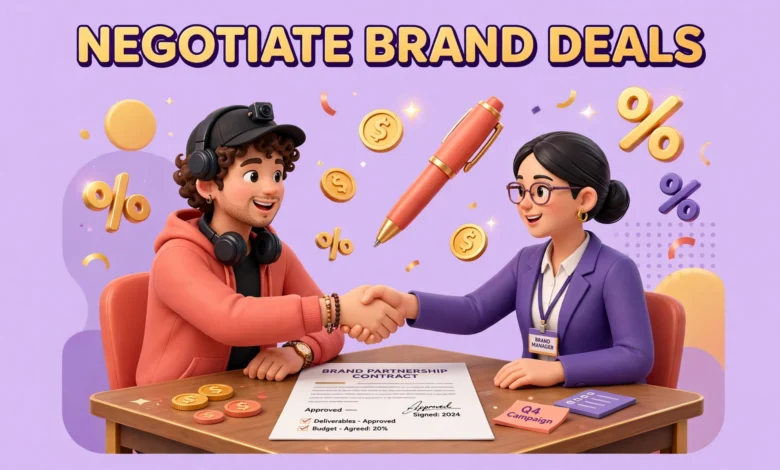
Most small creators leave money on the table, not because brands refuse to pay, but because creators never ask. A brand emails you, offers a free product and a small fee, and you say yes before you have read the brief properly. That habit costs you hundreds of dollars per deal, and it teaches brands that your work is cheap. Negotiation is not rude, and it is not only for big influencers. It is a normal part of doing business, and brands expect it.
This guide is about the negotiation itself: how to price your work, what to charge for usage rights and exclusivity, how to set limits on deliverables and revisions, how to ask for payment upfront, and when to walk away. If you are still at the stage of landing your first collaboration, read our guide on how to get brand deals with small followers first, then come back here before you reply to the next offer.
Why Negotiating Matters Even With a Small Audience
Brands do not pay for follower count alone. They pay for trust, for a specific audience, and for content that converts. A creator with 5,000 engaged followers in a clear niche can drive more sales than an account with 100,000 passive followers. If your audience matches the brand, your recommendation carries weight, and that weight has a price.
Negotiation also protects your time. A single sponsored post takes hours: planning, filming, editing, captioning, posting, and replying to comments. If you accept 50 dollars for work that takes six hours, your real rate is under 10 dollars per hour before tax and fees. The first number a brand offers is almost never its final budget, because brands often start low knowing many creators accept the first offer.
How to Price Yourself: Simple Formulas That Work
Start with a base rate, then adjust for the size of the job. A common starting formula is 100 dollars per 10,000 followers for one feed post or one short video. That gives a creator with 5,000 followers a base rate of about 50 dollars, a creator with 20,000 followers about 200 dollars, and a creator with 50,000 followers about 500 dollars.
Engagement based pricing is more accurate. Look at your average views and engagement rate over the last 30 posts, not your best post. A common benchmark is 10 to 20 dollars per 1,000 views for a short video, and 5 to 10 dollars per 1,000 views for a static post, with higher rates in valuable niches like finance and health. If your videos average 20,000 views, a fair starting range is 200 to 400 dollars per video. Our guide on how to price sponsored posts as a creator gives more worked examples you can adapt to your niche.
- Base rate: Start from 100 dollars per 10,000 followers, then adjust for views and engagement.
- Views matter more: Price from average views over the last 30 posts, not from follower count alone.
- Niche premium: Finance, tech, and business audiences usually command higher rates than general lifestyle.
- Bundle discount: Offer 10 to 15 percent off for three or more deliverables, never for a single post.
- Minimum fee: Set a floor, for example 100 dollars, below which you do not accept sponsored work.
Usage Rights: Why They Cost 30 to 50 Percent Extra
Usage rights are the most misunderstood part of a brand deal, and the most expensive mistake to make. When a brand pays for a post on your account, that is one use. When it also wants to run your video as a paid ad, post it on its own channels, or put it on its website, that is extra value, and it must be priced separately.
A fair rule is to add 30 to 50 percent of your base fee for limited paid ad usage for 30 days, and 50 to 100 percent for longer or wider use. If your base fee is 300 dollars for a Reel, charge 400 to 450 dollars if the brand wants to run it as an ad for one month. Always put usage in writing: which channels, which formats, and how long. If the contract says unlimited usage forever for the base fee, do not sign it. Ask for a 90 day limit, and a renewal fee if the brand wants to keep using the content after that period.
Exclusivity Clauses: Get Paid for Saying No to Competitors
Exclusivity means you agree not to work with competing brands for a set period. That limits your future income, so it must be paid for. A common benchmark is an extra 20 to 30 percent of your base fee for 30 days of exclusivity in one category, and more for 60 or 90 days. Keep exclusivity narrow: it should cover direct competitors in one category, not a whole industry. Ask for the exact list of competitors in writing, and refuse broad exclusivity that blocks unrelated income. If the brand will not pay for exclusivity, do not accept it.
Deliverables, Revisions, and What to Ask in the Brief
Before you quote a price, ask for a clear brief. You need to know the exact deliverables, the platform, the posting date, the key message, and the approval process. A vague brief leads to extra work, so get the details in writing before you agree.
- Deliverables: How many videos, posts, or stories, and on which platforms? One Reel is not the same as a Reel plus three stories plus a feed post.
- Revisions: Include one round of reasonable revisions in your fee. Charge extra for a second round, and set a clear limit, for example two rounds maximum.
- Approval time: Ask how long the brand takes to approve a draft, and set a posting window so a slow approval does not ruin your schedule.
- Timeline: Confirm the draft deadline, the posting date, and how long the post must stay live.
- Key message: Ask for the one message the brand wants, plus any claims you must avoid for legal or honesty reasons.
Put all of this in a short email before you start work. A simple summary protects both sides, and it gives you a record to point to if the brand asks for extra deliverables later.
Payment Terms: Ask for 50 Percent Upfront
Always ask for 50 percent upfront and the remaining 50 percent on posting or within 14 days of posting. This is standard practice for creators, and serious brands accept it without argument. It protects you from brands that disappear after you deliver the content, and it shows the brand is committed.
Agree on the payment method and the timeline in advance. Bank transfer, PayPal, Payoneer, or Wise are common for international deals. Confirm who pays the transfer fees, and confirm payment within 14 days of posting in writing. Keep a copy of every contract, brief, and invoice in one folder.
Negotiation Scripts You Can Copy and Adapt
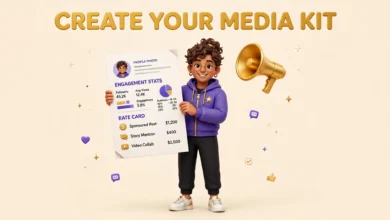
Use these short templates as a starting point. Change the numbers and the tone to fit your voice, but keep the structure: thank the brand, state your rate clearly, explain what it includes, and invite a reply. A professional media kit makes these conversations easier, because it shows your audience, your rates, and your past work in one document.
Template 1: Countering a Low Offer
Thank you for reaching out, I would love to work with you. My rate for one Reel is 300 dollars, which includes one round of revisions and posting to my feed. The rate you mentioned is below my minimum for sponsored work, but I can offer a bundle of one Reel plus three stories for 450 dollars if that helps your budget. Let me know if that works for you.
Template 2: Asking for Usage Rights Payment
Thanks for sharing the brief. I am happy to create the video for your campaign. For paid ad usage for 30 days, I add 40 percent to the base fee, so the total would be 420 dollars. That covers use on your social channels and as a paid ad. If you would like longer usage, I can quote for 90 days as well. Please let me know how you would like to proceed.
Template 3: Asking for Payment Upfront
I am excited to get started. My standard terms are 50 percent upfront to confirm the booking, and the remaining 50 percent within 14 days of posting. I will send an invoice for the first half once you confirm, and I will share a draft for your approval before the posting date. Please let me know if those terms work for you.
Red Flags and When to Walk Away
Not every deal is worth taking. A brand that offers only free product for a post that takes hours of work is not valuing your time, unless the product is genuinely high value and you truly want it. A vague brief with no deliverables, no timeline, and no budget is a sign of a disorganised campaign. For a wider view of creator income, read our guide on how to make money as a small creator.
- Free product only: Accept only if the product is high value, you want it, and the work is minimal. Otherwise, ask for a fee.
- Unlimited usage: Never agree to unlimited, forever use of your content for a standard fee.
- Unlimited revisions: Cap revisions in writing. Unlimited revisions mean endless rework for one fee.
- Pressure to sign fast: A brand that rushes you to sign today may be hiding bad terms. Take time to read the contract.
- Payment after 60 days: Long payment terms without an upfront payment are a cash flow risk for a small creator.
- Asking you to mislead: Never agree to hide a sponsorship, make a false claim, or pretend you use a product you do not use.
Walking away from a bad deal is a business decision, not a failure. A polite no keeps the door open for a better offer later, and it protects your audience trust, which is your most valuable asset. Our 30 day plan at https://vutechgeek.com/grow-on-instagram-in-30-days/ shows how consistent content raises both reach and negotiating power over time. For general guidance on creator business practices, the U.S. Chamber of Commerce site has useful small business resources.
Frequently Asked Questions
How much should I charge for my first brand deal?
Start from 100 dollars per 10,000 followers for one post or video, then adjust for your average views and engagement. If your videos average 10,000 views, a starting range of 100 to 200 dollars is fair. Set a minimum fee you will not go below, and raise your rate after every few successful deals.
Should I accept a free product deal as a small creator?
Accept a free product deal only when the product is high value, you genuinely want it, and the work is small, such as one story. For a full Reel or video that takes hours to make, ask for a fee as well. Free product does not pay your bills, and it sets a low price for your future work.
What is a fair fee for usage rights?
Add 30 to 50 percent of your base fee for paid ad usage for 30 days, and more for longer or wider use. Always limit usage by channel, time, and region in writing. Unlimited use forever should cost several times your base fee, because the brand can profit from your content for years.
When should I walk away from a brand deal?
Walk away when the brand offers only free product for major work, demands unlimited usage or unlimited revisions, pressures you to sign without reading the contract, asks you to mislead your audience, or refuses any upfront payment on a large project. A polite no protects your time, your rates, and your audience trust.
Last updated: November 2026.