

If you have spent any time looking for remote work online, you have probably seen ads promising easy money for training AI. Some of those ads are real opportunities. Many are exaggerated. Data annotation jobs for beginners sit somewhere in the middle. They are real, they are accessible without a degree, and they can pay decently for focused part time work. They are not, however, a guaranteed full time salary, and they are not as simple as clicking a button for hours.
This guide explains what the work actually involves, what beginners can realistically earn, which platforms are worth joining, and how to pass the qualification tests that stand between you and paid tasks. It also covers the parts that gurus usually skip: unpaid assessments, quiet weeks with no tasks, lower regional rates in Pakistan and India, and how to spot a scam before you waste time or money.
What is data annotation, exactly?
Data annotation means adding human judgement to raw data so a machine can learn from it. A photo on its own tells a model very little. A photo with boxes drawn around every car, pedestrian, and traffic sign tells it a great deal. A chatbot answer on its own is just text. A chatbot answer rated for accuracy, clarity, tone, and safety tells a training team whether that model is improving or getting worse.
Beginners usually start with general labelling tasks. These do not require coding or specialist knowledge. They require attention to detail, patience, consistent judgement, and the ability to follow detailed guidelines exactly. Speed matters, but accuracy matters more. Platforms track your quality scores closely, and workers who rush through tasks with sloppy labels lose access to better paying work fast.
One important branch is RLHF, or reinforcement learning from human feedback. In plain language, humans compare two AI responses and say which is better, or rewrite a weak response into a stronger one. If you can spot a factual error or a confusing sentence, you already have a valuable skill here.
What kinds of tasks will beginners actually do?
Most beginner work falls into a few clear categories. You will not do all of them at once. Platforms usually start you on one task type, measure your quality, and then open more work as you prove yourself reliable.
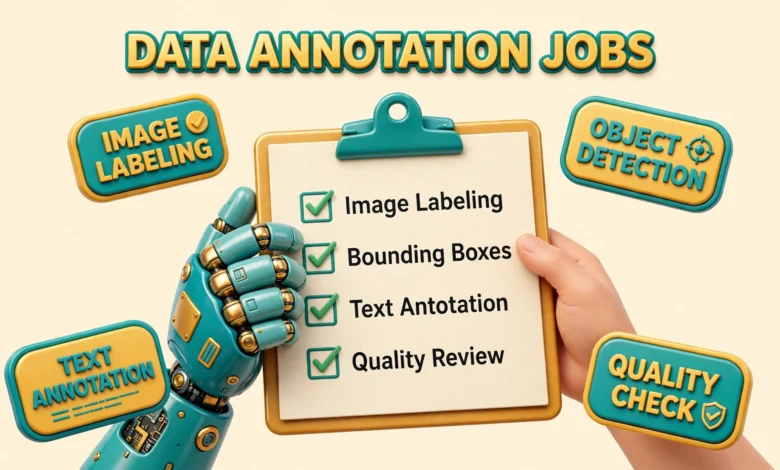
- Image labelling: drawing boxes, tracing outlines, tagging objects, and checking whether an image matches a description.
- Text labelling: sorting messages by topic or intent, flagging spam or harmful content, and marking names, places, and dates in a passage.
- Audio work: transcribing short clips, checking transcripts for errors, and rating voice clarity or pronunciation.
- Video work: labelling actions in short clips, marking the start and end of an event, and describing what happens in a scene.
- Chatbot rating and writing: comparing AI answers, ranking them by quality, rewriting weak answers, and writing prompts that test a model.
Who is this work actually suited to?
This work suits people who like quiet focused work and can follow detailed rules. Good annotators notice small differences, read instructions twice, and stay consistent across hundreds of similar tasks. If you enjoy proofreading or spotting errors in text, you will probably enjoy it.
It also suits people who need flexible hours. Much of this work is task based rather than shift based, so you can often work early in the morning, late at night, or in short blocks between other commitments. That flexibility is real, but it comes with a trade off. Flexible work usually means no fixed salary, no paid leave, and no guarantee of tasks tomorrow. Treat it as a strong side income first, and only as a main income once you have several months of steady task flow to judge by.
Strong English helps greatly, especially for chatbot rating and writing, because most high paying projects are in English. Demand is also growing for other languages, including Urdu and Hindi, for speech and text work. List every language you speak on applications, since it can unlock projects others never see.
How much do data annotation jobs really pay?
Pay varies by task type, platform, language, and region, so any single number online is probably misleading. Entry level general labelling commonly pays 10 to 20 dollars per hour when tasks are available. Specialist work, such as expert chatbot training or maths reasoning, can pay 25 dollars per hour or more.
That hourly figure needs context. You are usually paid per task, not per hour on the clock, so your effective rate depends on speed and accuracy. Also, task availability is uneven. Judge monthly income as an average across busy and quiet periods, not your best week multiplied by four.
For workers in Pakistan and India, some platforms set regional rates, so the same task can pay less than it pays a worker in the United States or Western Europe. That is frustrating, but the work can still be useful side income, especially with no commuting costs. Compare the rate with your time honestly, and skip projects where slow complex tasks push your real hourly pay too low.
Payout methods matter as much as the headline rate. Many platforms pay through PayPal or Payoneer, so check the minimum payout, schedule, and conversion fees before you start. For comparison, see our guide to best platforms for AI training jobs and our breakdown of how much AI training jobs pay by country.
Which platforms actually hire beginners?
You do not need to join every platform at once. In fact, joining too many and failing assessments on all of them is a common beginner mistake. Start with two or three well known platforms, complete their profiles properly, and focus on passing one assessment well rather than rushing through five.
- DataAnnotation: known for chatbot training and general AI tasks, with a structured assessment process and higher pay for strong contributors.
- Outlier: offers a wide range of AI training tasks, including writing, coding, and multilingual work, with project based availability.
- Appen: a long established crowdsourcing platform with many small labelling and search evaluation projects.
- Remotasks: focused on image, video, and 3D labelling tasks, often a good first step for visual work.
- Prolific: mainly academic and AI research studies, with clear pay per study and a reputation for fair treatment of participants.
- Toloka: a large microtask platform with many small tasks, useful for learning the basics, though pay per task can be low.
- OneForma: offers language, transcription, and data collection projects, including work in multiple languages.
DataAnnotation and Outlier tend to suit beginners because their AI training projects are well explained and can pay better than basic microtasks. Appen and Remotasks offer steadier simpler labelling volume. Read the official pages for DataAnnotation and Outlier before applying.
How do you get hired, and how do you pass the tests?
Almost every serious platform uses an unpaid qualification test, often called an assessment. This is normal, and it is also where most beginners fail. The assessment is not a formality. It tests whether you read guidelines carefully, follow them exactly, and make consistent judgements. Platforms would rather reject a careless worker early than fix hundreds of bad labels later.
Prepare like for a short exam. Read every guideline slowly, note edge cases, and do practice examples twice. Assessments love borderline cases, so study those carefully. Do not rush. A slower careful assessment that you pass is worth far more than a fast one that gets you rejected.
For DataAnnotation specifically, the assessment often involves reading, writing, and reasoning tasks rather than simple labelling. Strong, clear writing helps, as does showing your reasoning step by step when asked. Our detailed walkthrough on how to pass the DataAnnotation assessment covers the format and common mistakes in more depth, and it is worth reading before you start that particular test.
The honest caveats: feast or famine, and scams
The biggest surprise is uneven work flow. A client launches a large project, tasks flood in for weeks, then the project pauses for review. Workers who budget around busy weeks feel quiet weeks hard. Save part of busy week earnings, keep more than one platform active, and build skills for specialist projects, which tend to last longer than basic labelling.
Finally, the scam warning, stated plainly. Legit platforms never charge applicants. You should never pay a joining fee, a training fee, a deposit for equipment, or a fee to unlock higher paying tasks. If someone on WhatsApp, Telegram, or social media asks you to pay before you can start earning, walk away. Real platforms earn money from clients who need data labelled, not from workers hoping for a job. Also be wary of anyone promising a fixed high salary for simple tasks with no assessment. Real AI training work always involves screening, guidelines, and quality checks.
A simple starter routine for your first 30 days
Start structured. In week one, join two platforms and complete your profiles. In week two, attempt one assessment with full focus. In week three, if accepted, work in short blocks and track time and earnings by task type. In week four, review honestly and double down on what gave steady tasks and fair pay.
Data annotation will not make you rich overnight. It can give real remote income and a practical entry point into AI work without a degree or upfront cost. Pass one assessment well, protect your quality score, and treat quiet weeks as normal. That steady approach separates consistent earners from beginners who quit after the first slow week.
Frequently asked questions
Do I need a degree for data annotation jobs?
No. Most beginner platforms do not require a degree. They require good language skills, attention to detail, and a passing score on their qualification test. Specialist projects may ask for subject expertise, but general labelling and chatbot rating work is open to beginners who can follow guidelines well.
How long does it take to start earning?
It varies. Profile setup takes a day, but assessments, review, and project matching can take days or weeks. Some workers get tasks within a week of passing. Others wait longer for a project that matches their language and skills. Apply to more than one platform so a slow start on one does not stall you completely.
Are data annotation jobs safe and legitimate?
Work on established platforms is legitimate, but the field attracts scams. Stick to well known platforms, never pay to join, and be cautious about recruiters who contact you privately with urgent offers. If an offer skips any assessment and promises high fixed pay for simple work, treat it as a warning sign.
Can this become a full time income?
It can for some experienced workers, especially those who qualify for specialist projects across several platforms. For most beginners, it works better as a flexible side income at first. Build a quality record, track your real hourly earnings across busy and quiet weeks, and only rely on it as a main income once the numbers prove steady over several months.
Last updated: October 2026.