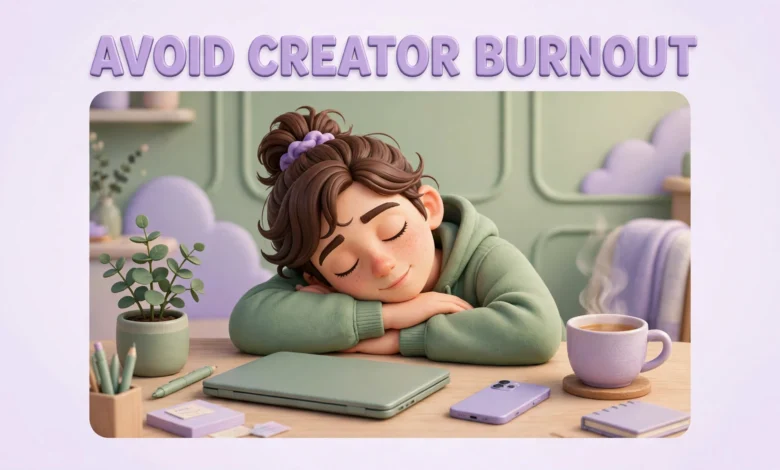
Creator burnout in 2026 is not a lack of discipline, and it is not a sign that you are lazy. It is what happens when the demands of constant posting outrun your energy, your time, and your reasons for creating in the first place. Almost every creator who has posted for more than a year has felt it.
This guide explains how to avoid creator burnout in 2026 with practical systems, not hustle culture advice. You will learn what burnout is, the warning signs, the causes, and the systems that keep small creators going for years instead of months. A break is not failure. It is maintenance, and creators who treat it that way last longer than creators who treat rest as a reward they never earn.
What Is Creator Burnout, Really?
The World Health Organization describes burnout as an occupational phenomenon with three parts: exhaustion, growing cynicism or detachment from the work, and reduced professional efficacy. In plain language, that means you are tired in a way that sleep does not fix, you start to feel negative or numb about the work you once enjoyed, and you get less done even when you try harder. You can read the full definition on the World Health Organization burnout page.
Creator burnout follows the same pattern, with one extra ingredient: the work never closes. A teacher or an office worker leaves the workplace at the end of the day. A creator carries the workplace in a pocket, and the audience, the comments, the analytics, and the pressure to post are available at midnight, on weekends, and on holiday. That always-on quality is why creators burn out faster than their workload alone would suggest.
It is also important to say what burnout is not. It is not the same as a bad week, and it is not the same as depression, although the two can overlap. If low mood, exhaustion, or hopelessness last for weeks, interfere with eating or sleeping, or make daily life hard, talk to a doctor or a mental health professional rather than trying to fix it with a better content calendar.
What Are the Warning Signs of Creator Burnout?
Burnout rarely arrives all at once. It builds slowly, and the early signs are easy to dismiss as a busy week. A weekly check-in with yourself, even a two minute note, helps you catch them early.
- Dread before posting: you delay filming for hours, or feel a knot in your stomach.
- Obsessive metric checking: you refresh views many times a day and your mood follows the numbers.
- The comparison trap: you measure your worst day against another creator’s best video.
- Creative fatigue: every idea feels used up and filming feels like a chore.
- Irritability with your audience: harmless comments now feel like demands.
- Physical signs: poor sleep, headaches, eye strain, and tiredness a weekend off does not fix.
One sign on its own is normal. Three or more, lasting for two weeks or longer, is a warning. That is the moment to change the system, not to push harder through it.
Why Does the Creator Economy Burn People Out?
Burnout is usually treated as a personal problem, but for creators it is mostly a structural one. Understanding those pressures makes it easier to design defences instead of blaming yourself.
Algorithm pressure is the biggest cause. Platforms reward frequency and recency, so taking a week off can cut your reach, and returning feels like starting over. The truth is less dramatic: a week off usually costs some reach, but a month of burnt out, low quality posting costs far more.
Always-on direct messages are the second pressure. Followers, brands, and strangers can reach you at any hour, and many creators feel guilty for not replying quickly. Financial insecurity is the third. When income depends on views, sponsorships, or affiliate sales, every quiet week feels like a pay cut, and that stress follows you into evenings and weekends.
How Many Times a Week Should You Actually Post?
For most small creators, three to five quality videos a week beats daily posting. A creator who posts four good videos a week for a year publishes more than 200 videos. A creator who posts daily for six weeks, burns out, and disappears for three months publishes fewer, and loses the audience habit that matters most.
Pick a cadence you can hold on your worst week, not your best one. If you work a full time job or you study, three videos a week may be your honest maximum, and that is fine. A missed day is not a failure. It is a day you chose to protect the next month of videos. One genuinely helpful video earns more saves and shares than five rushed ones.
How Do Content Pillars and Batching Prevent Burnout?
Content pillars are the three to five topics you return to again and again, and they are the single best cure for the daily panic of “what should I post today?” When your pillars are set, every new idea is a variation on a topic you already know, not a search for a brand new subject. If an idea does not fit a pillar, it does not get made, which saves you from chasing every trend.
Batching is the habit that turns pillars into a workable week. Instead of filming, editing, and posting one video a day, you do each task in a single block. Our guide to content batching for creators walks through a full batching workflow you can copy. Batching also protects your energy, because switching between tasks all day is exhausting. Keep a running list of ideas on your phone, and never sit down to film with a blank page.
How Do You Set Boundaries With Your Audience and Your Phone?
Boundaries are not rude. They are the reason you can keep showing up for your audience for years. The most useful boundaries for creators are simple, and they work best when you announce them once and then hold them quietly, without apologising every time. They protect your energy, your evenings, and your days off, so you can keep showing up for years.
- Set DM hours: check messages once or twice a day at set times, and use a pinned story or a bio line to say when you reply.
- Turn off analytics notifications on your phone, and check your numbers once a day at a fixed time instead of all day.
- Use saved replies for the five questions you get asked most often, so answering them costs you seconds, not minutes.
- Keep one phone-free hour before bed and one phone-free morning each week, with no exceptions for trends.
- Say no to collaborations, trends, and formats that do not fit your niche, even when other creators are doing them.
The comparison trap needs its own boundary. Unfollow or mute accounts that make you feel behind, even if they are creators you admire. Spend that attention on your own audience instead.
Money boundaries matter too. If your income depends on creating, keep a small buffer, even one month of expenses, before you scale up your spending on gear or courses. Our guide to make money as a small creator in 2026 explains how to build several small income streams, so no single slow month can sink you.
What Does a Real Rest and Recovery Plan Look Like?
Rest is not what happens when you collapse. It is a plan, and a good plan has three layers: daily rest, weekly rest, and real breaks. Daily rest means a hard stop time for creating, a walk or a meal without a screen, and sleep that you protect like a filming day. Weekly rest means at least one full day each week with no filming, no editing, and no analytics.
Real breaks are longer, and they need a little preparation. Before a break, tell your audience in one short video or post, schedule a few evergreen videos if you can, and then step away properly. A week away will cost you some reach, and most creators find their audience is still there when they return, often more engaged because the returning creator has energy again. Recovery takes weeks, not a weekend, so restart with one video a week on a topic you like, and add a second only when the first feels easy.
When Should You Take a Break, and When Should You Quit?
Take a break when you still care about the work but you are exhausted by the pace. That is the most common situation, and it is the one a break fixes. The signs are tiredness, irritability, and a loss of ideas, paired with a quiet feeling that the topic still matters to you underneath the fatigue. A break of one to four weeks, with the systems in this guide waiting for your return, is the right answer.
Consider a bigger change, not necessarily quitting, when the break does not help. If you return rested and still feel dread, if you have lost interest in the topic itself rather than the workload, or if the work consistently harms your health or your relationships, something structural needs to change. That change might be a new niche, a slower cadence, a different format, or a pause of several months. Quitting one channel is not quitting creating. One honest note for part-time creators: you do not owe anyone a full time output on a part-time schedule. Our guide to grow on Instagram in 30 days is built around a sustainable habit, not a sprint.
FAQs About Avoiding Creator Burnout
How do I know if I am burnt out or just tired?
Tiredness improves with a good night of sleep or a weekend off. Burnout does not. If exhaustion, dread before posting, and a loss of interest last for two weeks or longer, and rest does not help, you are likely dealing with burnout. That is the point to change your system and consider talking to a health professional.
How many videos a week should I post to avoid burnout?
For most small creators, three to five quality videos a week is sustainable. Pick a cadence you can hold on your worst week, not your best one, and keep it steady for months. A creator who posts four good videos a week for a year publishes more than 200 videos.
Will taking a week off ruin my growth?
A week off usually costs some reach, but it rarely ruins growth. Most creators return to a similar audience size within a few weeks. A month of burnt out, low quality posting costs far more than a short break, because it teaches your audience to scroll past you.
What should I do if burnout lasts for months?
Do not try to fix it alone with a better content calendar. Talk to a doctor or a mental health professional, especially if low mood, exhaustion, or hopelessness persist for weeks or interfere with eating, sleeping, or daily life. You can also step back, change your niche, or pause entirely. Your health comes before any posting schedule.
Last updated: November 2026.