If you already make short-form videos, starting a podcast is the easiest way to go deeper with the audience you have. Your Reels and TikToks win attention in seconds, but a podcast wins trust over thirty or sixty minutes. Listeners hear your real voice and real opinions, and that connection is hard to build in a 30-second clip.
This guide shows you how to start a podcast as a creator in 2026: pick a niche and format, test your idea before spending money, record with budget gear, and launch with a plan that gives you a real chance of reaching episode ten. The honest version is included too. Most podcasts fade out before episode seven, growth is slow, and gear is never the reason a show succeeds or fails.
Why Should a Short-Form Creator Start a Podcast?
Short-form content is great for discovery, but it is a poor place to build a deep relationship. A viewer might watch fifty of your videos and still not know what you really think. A podcast listener who finishes a full episode knows your opinions, your stories, and your sense of humor. That depth is why podcast listeners are more likely to buy from you or join your community.
A podcast also gives you a content engine. One recorded conversation can become a full episode, five short clips for TikTok and Reels, a quote post, and a newsletter issue. You record once and slice the best moments across every platform where your audience already follows you. Our guide to grow on YouTube Shorts in 2026 covers the short-form side of this system.
How Do You Pick a Niche and Format?
Your podcast niche should be narrower than your social media niche. On TikTok the algorithm finds the right audience for each video. A podcast does not work that way. Start with the topic your audience asks about most. “Money advice” is too broad. “Money advice for freelance designers in their first year” is a niche a listener can picture.
Next, pick a format you can sustain. Solo shows are easiest to schedule, but hardest to keep interesting for an hour. Interviews bring fresh voices, but need booking and prep. Co-hosted shows are fun, but need both people to commit. Pick the format you will still enjoy in six months. Then choose audio-only or video. Video opens up YouTube and gives you clips, but adds lighting and editing work. Many creators start audio-only and add video later.
What Is the 10-Episode-Ideas Test?
Before you buy any gear, sit down and write ten episode ideas. Not ten vague topics, ten specific titles with a one-sentence description of what the listener will learn. If you can write ten without struggling, you have a show. If you stall at number four, your niche is too narrow or too boring, and it is better to find out now than after you have spent money. Build it from your five best short videos plus five questions your audience keeps asking.
Record a test episode before you commit to a launch date. Talk into your phone for twenty minutes about your first episode idea, then listen back. You will hear your pacing and whether the topic actually fills twenty minutes. A test episode costs nothing and saves you from launching a show you do not enjoy making.
What Gear Do You Actually Need to Start?
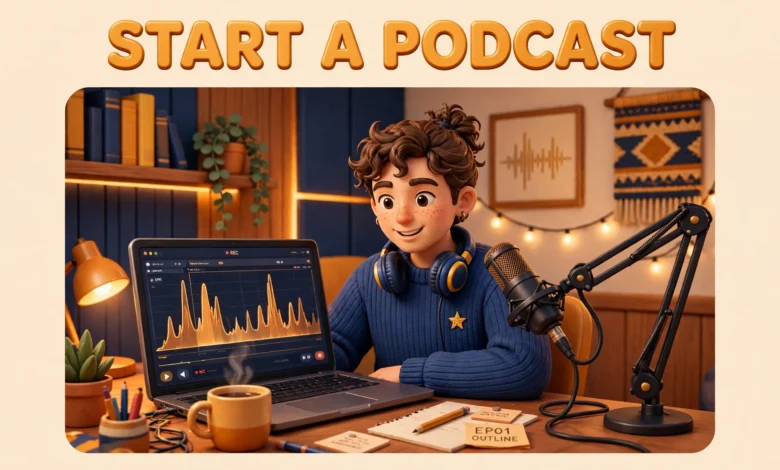
Here is the honest truth about podcast gear: it is not the bottleneck. A clear voice in a quiet room beats an expensive microphone in an echoey kitchen every time. You can start with your phone and a free app, and many successful shows did exactly that. Spend money only after you have recorded a few episodes and know you will keep going.
When you are ready for a real microphone, a USB mic is the best beginner choice. The Samson Q2U, usually around $80, plugs straight into your computer and sounds far better than a laptop mic. Avoid cheap condenser mics that pick up every sound in the room. Add wired headphones and a pop filter that costs a few dollars. Your room matters more than any of this, so record in the smallest, softest room you have.
How Do You Record and Edit Your Episodes?
Recording is simpler than most beginners expect. Open your software, press record, and talk. Keep a short outline on screen, not a full script. A script makes you sound like you are reading, while an outline lets you sound natural.
Audacity is free and handles everything a beginner needs: recording, cutting mistakes, removing noise, and exporting an MP3. GarageBand is a good free option on Mac. Descript is a paid tool that lets you edit audio by editing a transcript, and it creates video clips for promotion. Start free, and pay only when a feature saves you real time. Editing does not need to be perfect. Cut the long pauses and false starts, then stop.
How Do Hosting and Distribution Work?
A podcast host stores your audio files and creates an RSS feed, which tells Apple Podcasts, Spotify, and other apps where your episodes live. You upload once to your host, and your episode appears everywhere automatically. Spotify for Creators is a popular free starting point. Buzzsprout is a well-known paid host with a simple interface and good analytics.
Apple Podcasts does not host audio itself, so you submit your RSS feed there through Apple Podcasts Connect. Check the current steps on Apple Support and on Spotify for Creators before you submit. If you record video, upload the full episode to YouTube as a video podcast, a major place where people discover podcasts. Submit your show at least a week before launch, because approval usually takes a few days.
How Do You Name Your Show and Design Cover Art?
Your show name should say what the show is about in five seconds. A clever name nobody understands is a bad trade. Include a keyword if you can do it naturally, because people search podcast apps the same way they search Google. “The Freelance Designer Show” will be found. “Coffee and Chaos” will not, unless you are already famous. Check the name on Apple Podcasts and Spotify first.
Cover art is your show’s first impression in a crowded app. It needs to be readable at thumbnail size, which is tiny. Use a clear photo of yourself or a bold illustration, one or two words at most, and high contrast colors. Our guide to the best AI tools for content creators in 2026 includes design tools for cover art and episode graphics.
How Should You Launch Your Podcast?
Record three episodes before you launch. This is the single best launch advice for a beginner. It gives you a buffer and gives a new listener three episodes to binge. A listener who finishes episode one and finds nothing else will forget you. Launch with a short trailer too, a minute or two that tells people what the show is and when new episodes arrive.
Promote the launch where your audience already is. Cut each episode into two or three short clips, thirty to sixty seconds each, and post them on TikTok, Reels, and Shorts with a hook from the best moment. Pick a realistic schedule and keep it. Weekly is the standard, but a show that publishes every two weeks for a year beats a weekly show that quits after a month.
- Announce the launch to your email list first, if you have one. Email converts better than any social post.
- Ask your first listeners to subscribe and leave a review in the first week. Early reviews help a new show get noticed in the podcast apps.
- Publish a newsletter issue about the launch. If you do not have a newsletter yet, our guide on how to grow a newsletter as a creator in 2026 shows why one is worth building alongside your show.
What Growth Should You Realistically Expect?
Podcast growth is slow, and anyone who tells you otherwise is selling something. A new show often gets a few dozen downloads per episode in the first months, mostly from friends, existing followers, and a handful of curious strangers. That is normal. Podcasts grow through word of mouth, guest appearances, and recommendations, all of which take time to build.
Most podcasts quit before episode seven, and that fact is actually good news for you. If you reach episode ten, you have already outlasted most of the shows that launched the same month you did. Consistency beats frequency here. One episode a week for a year will build a bigger audience than a daily show that burns out in a month. Ten listeners who write to you are worth more than a hundred who never come back.
How Do Podcasts Make Money?
There are several ways a podcast can earn money, but none of them pay well at small sizes, so be honest with yourself about the timeline. Sponsorships are the most common route. A sponsor pays you to read an ad in your episode, and rates depend on downloads. Sponsors care about a loyal, specific audience more than a big, vague one.
Paid subscriptions are a second route. Spotify for Creators and Apple Podcasts both let you offer paid subscriber-only episodes or an ad-free feed. Affiliate links are the easiest monetization to start: recommend a tool or piece of gear you actually use and link it in the show notes. The most realistic early income is indirect. A podcast can sell your own services, courses, or products far better than a social post can.
What Mistakes Do New Podcasters Make?
- Buying expensive gear before recording a single episode, then discovering they hate editing.
- Choosing a niche that is too broad, so no listener can explain what the show is about.
- Launching with one episode and no buffer, then missing week two and losing momentum.
- Spending three hours editing a thirty-minute episode and burning out before episode five.
- Quitting at episode five because growth felt slow, just before consistency would have paid off.
FAQs About Starting a Podcast as a Creator
Can I start a podcast with just my phone?
Yes. You can record on your phone with a free app like your voice recorder or Spotify for Creators, and many shows started exactly that way. Upgrade to a USB mic like the Samson Q2U only after a few episodes, when you know you will keep going.
How much does it cost to start a podcast in 2026?
You can start for free with your phone, Audacity, and a free host like Spotify for Creators. A sensible beginner setup costs around $100 to $150: a USB mic around $80, wired headphones, and a pop filter. Spend no more until your show is growing.
How long should podcast episodes be?
Solo episodes usually work best at 20 to 40 minutes, while interviews often run 45 to 60 minutes. The right length is the time your topic actually needs. A tight 25-minute episode that respects the listener’s time beats a padded hour every time.
How do I get my podcast on Spotify and Apple Podcasts?
You upload your episodes to a podcast host, which creates an RSS feed for your show. Submit that feed to Spotify through Spotify for Creators and to Apple Podcasts through Apple Podcasts Connect. Approval usually takes a few days.
Last updated: November 2026.