Every creator fears posting a new idea to followers. You spent weeks building an audience that likes one kind of content, and now you want to try something different. Will followers scroll past it? Will it hurt your reach? Instagram trial reels solve exactly this problem, and in 2026 they are one of the most useful growth tools for small and mid sized creators.
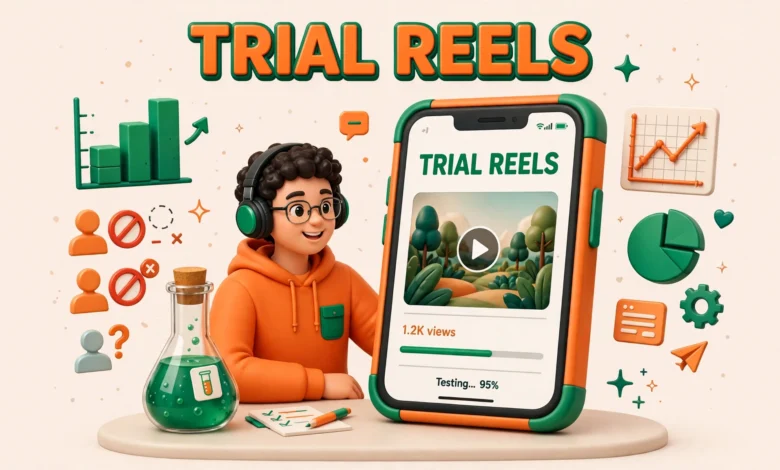
A trial reel is a reel Instagram shows to non-followers first. It stays hidden from your profile grid and followers’ feeds while it is tested. If it performs well with strangers, you can share it with followers, manually or automatically. If it flops, only strangers saw it. That makes trial reels a low risk way to test new hooks and niches.
This guide explains what trial reels are, how to post one, how to read results, and how to build a weekly testing routine, plus the caveats nobody mentions in hype posts.
What Is an Instagram Trial Reel?
A trial reel is a normal reel with one setting changed. When you turn on the Trial option before sharing, Instagram does not show it to followers and does not add it to your grid. Instead, it shows the reel to people who do not follow you, mostly through the Reels feed and Explore. Strangers judge the content on its own merits, without loyalty to you or history with your page.
Follower feedback can be misleading. Followers may watch out of habit or support, even if an idea would never travel beyond your page. Non-followers have no such loyalty. If they stop, watch, and share, that is a much stronger signal the idea has real reach potential.
How Is a Trial Reel Different From a Regular Reel?
The differences are about distribution, not format. A trial reel looks like any other reel and lives in your Reels tab while tested. What changes is who sees it first.
- Regular reels go to your followers first, then expand to non-followers if early engagement is strong.
- Trial reels go to non-followers first, and your followers only see them if you choose to share the reel with them later.
- Regular reels appear on your profile grid immediately, while trial reels stay off your grid during the test.
- A trial reel that performs well can be converted into a regular reel, at which point it behaves like any normal post on your profile.
You are not creating throwaway content. A winning trial can become a permanent part of your grid, and a losing trial can be deleted quietly at the cost of only your production time.
How to Post a Trial Reel Step by Step
You need a professional account, either Creator or Business, to use trial reels. Personal accounts do not have the option. Switching is free and takes less than a minute in your account settings.
- Create your reel as usual: record or upload your clips, add audio, text overlays, and captions.
- On the share screen, look for the Trial option and turn it on before you publish.
- Write the caption for strangers, not followers. A stranger has no context about you or your series, so the caption and first line of on-screen text must explain the value immediately.
- Choose a cover frame that makes sense to strangers. Avoid inside jokes.
- Decide on automatic sharing. With it on, Instagram shares the reel with followers if it performs well. With it off, you decide manually.
- Publish, then leave the reel alone for at least a full day before judging it.
Most trial reels fail not because the idea is bad, but because the creator wrote for followers. Phrases like “part 3 of my series” mean nothing to a stranger. Write every trial caption as if the viewer has never heard of you. For more on how Instagram decides what to show, read our guide to the Instagram Reels algorithm in 2026.
What Happens During the 24 Hour Test Window?
Instagram generally tests a trial reel for roughly 24 hours, though the exact window can vary. During this period the reel is shown to a sample of non-followers. Strong early signals can extend its reach, while weak signals end the test quietly. Checking every hour and panicking over slow early numbers helps nobody.
After about a day, you will have enough data to decide. Raw views are the least useful metric, because a view can mean one second watched before scrolling on. The metrics below tell you far more about whether an idea deserves a wider audience.
- Watch time and completion rate: how long strangers stayed, and how many watched to the end. High completion is the strongest sign the idea held attention.
- Shares and sends: strangers sending the reel to a friend is a powerful signal. It means the content felt worth passing on, not just worth watching.
- Follows from the reel: if strangers followed you after watching, the reel did more than entertain. It convinced them your page is worth returning to.
- Saves: a save means the viewer wants the information later, which is especially valuable for tutorials, tips, and how to content.
Likes, by contrast, are a weak signal in a trial. A stranger can double tap out of habit in half a second. Judge trials by depth of engagement, not by the like count. Instagram’s own help center explains how reels insights work.
How Does the 3 Hook Split Test Method Work?
The most practical use of trial reels is split testing hooks. A hook is the first two or three seconds of your reel, the moment that decides whether a stranger stays or scrolls. Most creators guess at hooks, but trial reels let you test them: take one solid idea and make three versions, each with a different opening.
- Version one opens with a bold claim or surprising result, for example the outcome before the explanation.
- Version two opens with a relatable problem the viewer already recognizes, stated in their own words.
- Version three opens with a question that creates curiosity, something the viewer cannot answer without watching.
Keep everything else the same: core message, length, and visuals. Post the three versions spaced out, and compare them after each test window. The winner tells you which hook style your audience responds to. This beats asking friends, because friends are kind and strangers are honest. Our guide to Instagram reels hooks that stop the scroll breaks down more styles to test.
Can Trial Reels Help You Enter a New Niche Safely?
Yes, and this is where trial reels shine for creators stuck in one topic. Suppose you run a fitness page but want to test personal finance content. Posting the new topic to followers risks confusion and unfollows if it misses. Testing it as a trial first means only strangers judge it, and you learn whether the niche has an audience before followers ever see it.
If the trial performs well, introduce the niche gradually, perhaps as a new series. If it performs badly, you have lost only production time, and your page’s identity stays intact. Test one new niche at a time, though. Testing five unrelated niches in one week tells you nothing clear about any of them.
Manual or Automatic Graduation: Which Should You Choose?
When a trial reel performs well, it can graduate, meaning it becomes visible to followers and appears on your grid. You can let Instagram do this automatically, or you can do it manually.
Automatic graduation is convenient. If a trial clears Instagram’s performance bar, it reaches followers without further action. The downside is control: you do not choose the timing, and a reel might reach followers at an inactive hour. Manual graduation gives you that control. You review results and publish at a time that suits your schedule. For most small creators, manual is better, since it forces you to look at the data and keeps your grid intentional. Our grow on Instagram in 30 days guide shows how testing fits into a consistent routine.
What Does a Simple Weekly Trial Reel Routine Look Like?
Trial reels work best as a habit. One or two trials per week is plenty, and it keeps the workload realistic alongside regular posting.
- Monday: pick one idea, a new hook for a proven topic or a first step into a new niche.
- Tuesday: post the trial with a stranger friendly caption, plus your normal content.
- Wednesday: do not check constantly. Let the test window run.
- Thursday: review watch time, completion, shares, and follows, then decide whether to graduate, rework, or discard.
- Friday: if the trial won, share it with followers or remake it with the winning hook refined.
Keep a simple log: the idea, the hook style, and the key metrics. After a month, patterns emerge, such as question hooks outperforming claim hooks. For broader strategy, Buffer’s Instagram growth guide is a solid reference.
What Are the Honest Caveats About Trial Reels?
Trial reels are useful, but they are not magic. First, one test proves very little. A single trial can overperform or underperform for reasons unrelated to quality, such as timing or the sample of strangers Instagram chose. Treat one result as a hint, not a verdict, and repeat a winning idea before building a series around it.
Second, trials do not fix weak content. If the idea is unclear, the pacing drags, or the value arrives too late, no distribution trick will save it. Creators sometimes blame the algorithm when the real problem is that the first five seconds gave strangers no reason to stay. Third, trial metrics are not directly comparable to regular reel metrics, since a trial audience is entirely strangers. Compare trials against other trials, not against your best regular posts.
- Do not post many near identical trials at once. Duplicates split your results and can look spammy.
- Do not judge a trial after two hours. Early numbers are noisy, and the test needs time to reach a fair sample.
- Do not graduate every trial with decent views. Share only ones with strong watch time, shares, or follows.
- Do not abandon regular posting while testing. Trials supplement your plan, they do not replace it.
Used with those limits in mind, trial reels genuinely reduce risk. They let you test boldly in private and publish confidently in public.
Frequently Asked Questions
Do my followers see my trial reels?
No, not during the test. Trial reels are shown to non-followers only and stay off your grid. Followers only see the reel if you share it later, manually or through automatic graduation after a strong test.
How long does the trial reel test last?
Roughly 24 hours is the general window, though it can vary. Wait at least a full day before judging results, because early numbers are noisy and the test sample is still building during the first few hours.
Can I turn a trial reel into a regular reel later?
Yes. If a trial performs well, you can share it with followers, at which point it appears on your grid like a normal reel. If it performs badly, delete it, and your followers will never have seen it.
Do trial reels guarantee more reach?
No. Trial reels guarantee a test audience, not a result. A weak idea will still perform weakly with strangers, and one good test does not prove long term success. Trials improve decisions, but content still has to earn attention.
Last updated: October 2026.