

Some posts with mediocre like counts keep getting pushed for weeks. Others with decent likes die within hours. The difference is almost always the same two signals: saves and shares. In 2026, Instagram treats a save as proof your content is worth returning to, and a share as proof it is worth spreading. Both carry far more algorithmic weight than a like. Here is how to earn more of them honestly, without gimmicks that can damage your account.
An honest framing first. Saves and shares are multipliers, not rescuers. A boring post will not suddenly reach a million people because you added “save this” to the caption. What they actually do is tell Instagram that the attention your post already earned was high quality, which makes Instagram show it to more people who never would have seen it otherwise. If your overall growth engine is still shaky, start with a broader plan like this 30-day Instagram growth guide and treat this post as the engagement layer on top of it.
Why Saves and Shares Outrank Likes in 2026
The like is the cheapest action on Instagram. It takes a tenth of a second and requires no thought. Years of data have taught the ranking system that likes correlate weakly with whether someone will care about your account tomorrow. Saves and shares demand intent. Nobody bookmarks a post they feel neutral about, and nobody forwards a Reel to a friend unless it genuinely struck a chord.
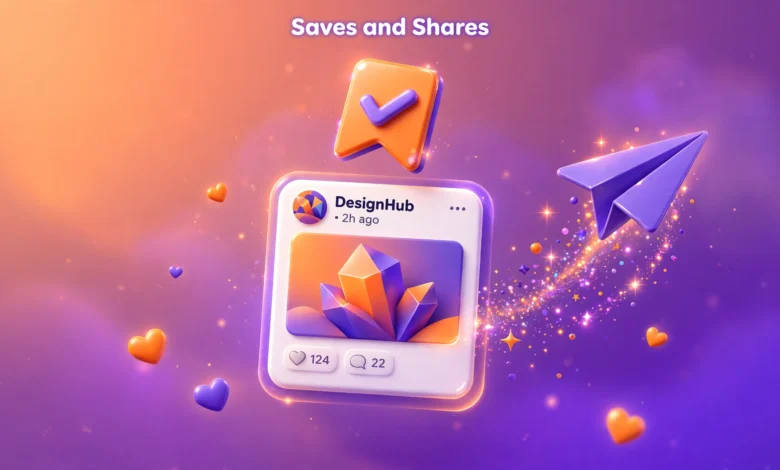
A save is a bookmark, a statement of “I want this later.” Instagram reads that as durable value. Saved posts feed the algorithm’s long tail: they resurface in Explore weeks after posting and signal reference value rather than throwaway entertainment.
Shares, especially DM sends, are the explosive signal. When someone sends your Reel to three friends, Instagram reads it as an endorsement chain. Those friends often open it immediately, and if they watch and react, Instagram pushes the post to more people like them. That is how a Reel from a 2,000-follower account can suddenly reach 200,000 viewers. The share is the closest thing Instagram has to word of mouth, and the algorithm is built to amplify it.
What Content Gets Saved? Formats Built for Bookmarks
People save content for one reason: they expect to need it later. If your post does not contain information worth referring back to, nobody will save it, no matter what your caption says.
Checklist and framework carousels
Carousels remain the king of saves. A 7 to 10 slide carousel that walks through a complete checklist is exactly what someone bookmarks for later. The structure that works: slide one is a bold promise, the middle slides are one tip each with a short explanation, and the final slide is a clean summary recap. This comparison of carousels vs Reels in 2026 digs deeper into when each format wins.
How-to Reels that solve one specific problem
Save-heavy Reels teach something in 30 to 60 seconds that the viewer cannot do yet. “Fix this one camera setting for sharper night photos” will outperform “my morning routine” every time, because one is a tutorial and the other is a diary. The tutorial gets saved for the next time the viewer is out at night. Keep the steps on screen as text so people can screenshot mid-video.
Reference content: lists, templates, comparisons
Anything that functions as a reference gets saved: price lists, tool comparisons, cheat sheets, packing lists, restaurant shortlists for a city. If a viewer thinks “I will need this exact thing next week,” the bookmark comes out. A single image that contains the entire reference often outperforms a multi-slide carousel for saves, because the viewer saves it as one quick-access image.
Before and after transformations
People save transformations as proof and as motivation, and to study how you got from A to B. Always include the method, not just the result. A transformation without the steps gets likes. A transformation with the steps gets saved.
What Content Gets Shared? Formats Built for Spreading
Sharing has a different psychology. Nobody shares to help the creator. People share because the content says something about them: it made them laugh, it expresses their opinion, or it contains a take they agree with and want validated. Design for the sharer’s motive, not your own.
Relatable Reels that name a shared experience
The most shared format on Instagram is the “this is so true” Reel: one hyper-specific observation, delivered in under 15 seconds, with on-screen text that works without sound. Specificity is everything. “Freelancer problems” gets scrolled past. “When the client says just one small change and it is a full rebrand” gets sent to three group chats.
Myth-busting and hot takes
Posts that challenge a common belief in your niche get shared as ammunition. Back the hot take with a result, a screenshot, or a number. A hot take with proof gets shared with “told you.” A hot take without proof gets scrolled past with “okay, sure.”
Niche humor and tag-worthy posts
Humor travels faster than advice because it carries no preaching weight. A meme template applied to your niche’s inside jokes is one of the highest share-rate formats on the platform. One caveat: humor earns shares but rarely earns saves or follows, so pair meme posts with value posts in the same week so new visitors see substance when they land on your profile. Tag-style posts (“send this to the friend who always shows up”) work too, but use them sparingly: one per month is a fun mechanic, five per week looks desperate.
Hook Formulas That Win the First Two Seconds
No save or share happens without a watch or a read, and you have roughly two seconds to earn either. Your hook lives in three places at once: the first frame’s on-screen text, the spoken first line, and the caption’s first line. All three should carry the same promise.
Hooks that earn saves promise a result: “3 settings that fix blurry Reels forever.” Hooks that earn shares promise recognition or disagreement: “Unpopular opinion: your hashtags are fine, your content is the problem.” Each tells the viewer exactly why the next 30 seconds are worth their time. Vague hooks have been abused for years and now trigger instant skepticism. Test the honest way: post the same idea with two different hooks a few days apart and compare save and share rates in Insights, not like counts.
The Save Slide and Send-to-a-Friend CTA Playbook
Calling out the action you want does increase it, but only when the request feels natural. The golden rule: ask for the save after delivering the value, not before.
- The save slide. Make your carousel’s final slide a clean recap with “Save this for later” in a corner. The reminder arrives at the exact moment the viewer might want the content again. Bonus: a clean recap slide gets screenshotted even by people who forget the bookmark button.
- The mid-Reel verbal CTA. Around the 70 percent mark of a tutorial Reel, say “Save this so you have it next time” while the step is on screen. It feels like helpful advice because you are mid-lesson.
- The friend send. “Send this to the one friend who always says they will start and never does.” One specific archetype beats “share with your friends” because the viewer immediately pictures a person.
- The caption closer. End with a one-line action tied to the content: “Bookmark this for your next launch week.” One ask per post. Asking for a like, comment, save, and share in the same caption dilutes all four.
One post should target one signal. A checklist carousel should ask for the save. A relatable Reel should ask for the send. Ask for both on every post and your audience tunes the asks out entirely.
How Should Your Caption Be Structured to Encourage Saves?
The caption is where casual viewers become savers. A save-friendly caption has four parts. Line one restates the hook as a promise. Line two expands with one detail the video did not have room for: the extra tip, the exact settings, the tool name. Lines three through five give the steps in short punchy lines with line breaks between them. Skimmability is what converts a reader into a saver. The closing line makes the single ask: “Save this for the next time you shoot at night.”
Two formatting notes. Front-load the keyword you want to rank for in the caption, because Instagram search reads captions and the first 125 characters matter most. And keep paragraphs to one or two lines. A caption that looks like a checklist gets bookmarked; a caption that looks like a textbook gets skimmed.
How Do You Track Saves and Shares in Instagram Insights?
Open any post, tap “View Insights,” and you will see saves and shares alongside reach and likes. The metric that matters is the rate, not the raw count: saves divided by reach, shares divided by reach. A post with 50 saves from 1,000 reach is outperforming a post with 200 saves from 50,000 reach.
Build a monthly review habit. List your top five posts by save rate and your top five by share rate, then look for patterns: always the checklist carousels? Always the hot takes? Double down on the winning format next month while keeping one or two experiments in the mix. Instagram’s own creator resources at creators.instagram.com also publish periodic guidance on what the ranking system rewards, worth checking when you want to confirm a trend instead of trusting a guru’s screenshot.
Does Posting Time Affect Your Early Save and Share Signals?
Yes, but not the way timing gurus claim. There is no universal magic hour. What timing actually controls is the quality of your first audience. Instagram tests every post with a small initial group before deciding how far to push it. If that first group is your most engaged followers, active and scrolling, they save and share at a higher rate and the post gets a stronger launch.
The practical move: check Insights, open Followers, and look at the “most active times” graph. Post in the first hour of your audience’s peak window. That is it. And once you have posted, stay online for 20 to 30 minutes and reply to early comments. Early conversation stacks with early saves and shares to give the post its strongest possible launch.
Honest Caveats: What Saves and Shares Cannot Do
Engagement pods and bought saves will wreck your reach. Pods are groups where members save and comment on each other’s posts to fake engagement. Instagram detects inauthentic patterns: saves from accounts that never watch your content, shares with zero watch time behind them. Flagged distribution gets throttled for months. Bought saves are worse: bot accounts with no real followers, and Instagram can see the mismatch. If a service promises guaranteed saves, it is selling you poison.
Saves cannot rescue weak content. If the first two seconds do not hook anyone, nobody sticks around to save the post. Fix the hook and the idea before you optimize the CTA. The CTA playbook multiplies existing value; it does not create it.
Save and share rates vary wildly by niche. Educational niches naturally earn more saves. Entertainment niches earn more shares. Do not compare your save rate to a finance creator’s if you run a comedy page. Compare yourself to your own past performance and to direct niche competitors.
Frequently Asked Questions
Do saves really help a post go viral on Instagram?
Saves help, but they do not cause virality on their own. A save tells Instagram your content has lasting value, which earns it longer distribution in Explore and home feeds. Virality still needs the full package: a strong hook, high watch or read completion, and shares that bring in new viewers. Think of saves as the fuel that keeps a good post running long after its first day, not the spark that starts the fire.
How many saves is considered good on Instagram?
There is no universal number because niches differ so much. The better benchmark is your save rate: saves divided by reach. If 1 to 2 percent of viewers save a post, that is a strong signal in most niches. Track your own average over a month and aim to beat it, rather than chasing someone else’s screenshot.
Should I ask followers to save my posts in every caption?
No. Asking for a save on every post trains your audience to ignore the request. Reserve the save CTA for posts genuinely worth saving: tutorials, checklists, reference lists, templates. For entertainment or opinion posts, a share CTA or a discussion question works better. One clear ask per post, matched to what the post actually delivers, will outperform a laundry list of requests every time. For the official word on how ranking weighs interactions, Instagram’s help center at help.instagram.com documents how feed ranking considers your activity.
Can shares from DMs really boost a Reel’s reach?
Yes. DM sends are one of the strongest signals Instagram measures because they represent a personal endorsement. When your Reel gets forwarded through DMs, the recipients usually watch it immediately and often react, creating a chain of high-quality engagement that the ranking system rewards with wider distribution. This is why relatable, tag-worthy Reels can explode from small accounts: every share is a warm introduction to a brand new viewer.
Last updated: October 2026.